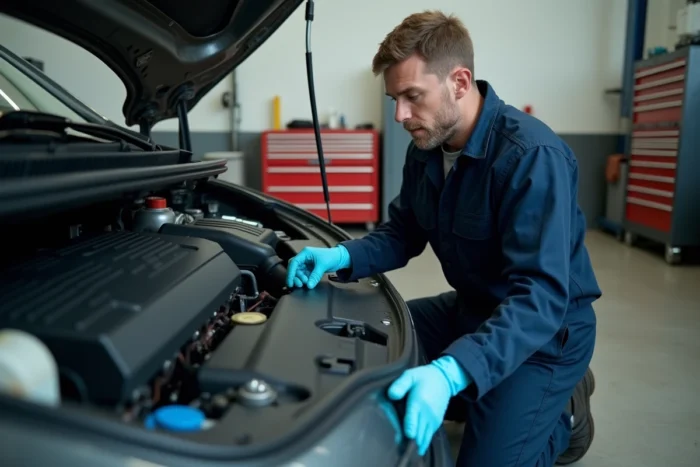
Dry run on a 308 HDi after a fuel filter change, and the engine refuses to start despite repeated attempts with the starter. This situation is common with this model, but priming the diesel circuit is not just about randomly pumping the bulb for an hour. On PSA 1.6 HDi engines, access to components varies by generation, and improper handling can turn a routine purge into a more complicated diagnosis.
Air intake on 308 HDi: check before priming
We often fall into the trap of pumping directly on the priming bulb without investigating the cause of the problem. If the bulb does not harden after several dozen presses, the issue rarely comes from the pump itself.
Field reports point to an air intake in the hoses or fittings of the fuel circuit. After a filter replacement, a poorly reconnected hose or a damaged O-ring is enough to let air in continuously. In this case, pumping is useless: the air is replaced as quickly as it is expelled.
Before any priming attempt, visually inspect the three hoses connected to the filter support and the electrical connector. On the 308, the fuel filter is located to the left of the air filter, above the engine oil cap. The priming pump, cylindrical and black, is situated between the two lower hoses. A guide detailing how to prime the fuel pump on a 308 HDi specifies the exact location according to the versions.
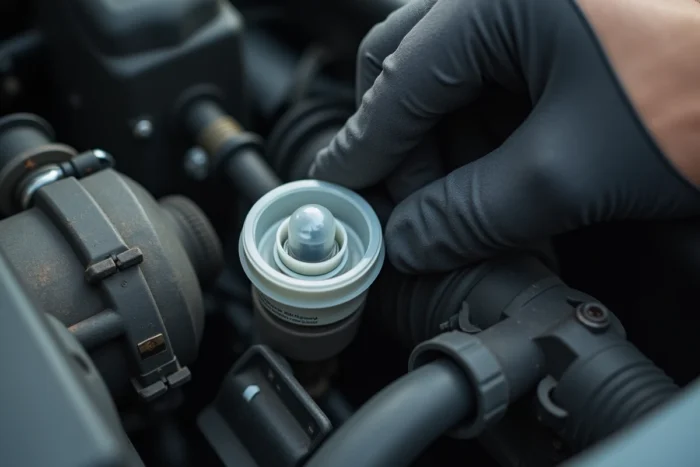
If diesel seeps at a fitting when pumping, the air intake is identified. You then need to disconnect the affected hose (by pressing on the colored part while pulling), check the O-ring, and reconnect it with a firm click.
Purge through the diesel injectors: the field method
The priming bulb is not always sufficient to expel air from the high-pressure circuit. When you have pumped correctly (the bulb eventually hardens) but the engine still does not start, there is likely trapped air in the pipes between the high-pressure pump and the injectors.
The most reliable method is to slightly loosen the high-pressure pipes at the injector side, then operate the starter in short sequences. You observe the diesel arriving at each loosened fitting. As soon as it flows without bubbles, tighten it by hand and then with a wrench, with the engine off.
Some precautions to follow for this purge:
- Operate the starter in sequences of a few seconds, with a pause between each attempt, to avoid draining the battery or burning out the starter.
- Place a clean cloth under each loosened fitting to absorb the flowing diesel and avoid any contact with hot engine parts.
- Tighten the fittings in order, one by one, checking for any seepage after repressurizing the circuit.
This approach works better than just the priming bulb because it addresses the circuit end to end. On the 308 HDi, the high-pressure circuit remains the last segment to be purged, and the bulb does not generate enough pressure to empty it alone.
Starter and battery 308 HDi: the limits of the classic method
A common reflex is to insist on the starter hoping that the circuit will purge itself. This is a mistake that can be costly. Prolonged demands on the starter with an unprimed engine cause a rapid battery discharge, sometimes in less than ten attempts.
In the field, it is noted that the battery of a 308 HDi with a few years of service struggles with this type of effort. If the voltage drops too low, the engine control unit won’t even initiate the injection sequence correctly, which skews the diagnosis. One might then think there is a problem with the pump or injectors when the starter is simply turning too slowly.
The best practice: three to four starter attempts maximum, each lasting a few seconds. If the engine does not start, revert to manual purging before trying again. And if a jump cable or booster is available, now is the time to use it to ensure sufficient voltage.
OBD2 scanner and fault codes: distinguish a priming issue from a real breakdown
When the priming has been done correctly (bulb hardened, purge at the injectors, battery in good condition) and the engine still refuses to start, the problem lies elsewhere. This is where an OBD2 check becomes a useful step.
Connecting a diagnostic scanner or a simple OBD2 reader allows you to read the fault codes recorded by the control unit. We primarily look for:
- A fault on the common rail pressure sensor, which would indicate a pressure issue independent of the priming.
- A code related to the high-pressure pump itself, signaling a mechanical or electrical failure.
- A fault in the electrical supply to the lift pump (located in the tank on some versions), which would prevent fuel from reaching the filter.
Reports vary on this point: some faults disappear after clearing and restarting, while others persist and require part replacement. Without a scanner, there is a risk of changing components at random.
Priming a 308 HDi remains an accessible operation if done methodically. Look for air intake before pumping, purge the high-pressure circuit at the injectors, and do not persist with the starter are the three reflexes that make the difference between a clean restart and a tow truck.