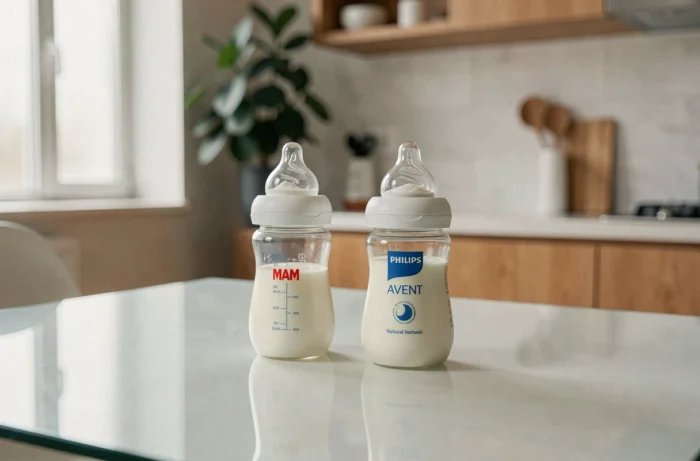
When transitioning from exclusive breastfeeding to mixed feeding, or simply looking for a reliable anti-colic bottle, the choice often narrows down to two options: the Mam Easy Start and the Philips Avent Natural Response. Both dominate the baby product aisles, but their design logic differs in ways that affect daily routines.
Anti-colic system: Mam’s ventilated base vs. Avent’s valve
The first reaction when an infant swallows air is crying and discomfort after feeding. Both brands offer an anti-colic device, but the mechanism is not the same.
With Mam, air enters through the base of the bottle thanks to a perforated and ventilated bottom. The milk remains on the surface, and air circulates below without creating bubbles. In practice, there is less foam during preparation, which reduces the amount of air mixed with the milk.
At Philips Avent, it is a valve integrated into the nipple (AirFree valve on some models) that prevents air from descending into the milk. The principle is different: instead of ventilating from the bottom, air is blocked at the level of the nipple itself.
Feedback varies on this point, but parents dealing with significant colic often lean towards Mam, whose base ventilation system seems more effective in managing air. Those practicing mixed feeding tend to prefer the Avent valve, which allows for a more natural on-demand feeding rhythm.
To delve deeper into this comparison between Mam and Philips Avent bottles, it is also important to look at the nipple and cleaning aspects, two criteria that are at least as decisive in daily life.

Silicone nipple and baby acceptance: Mam SkinSoft vs. Avent Natural Response
The nipple is often the deciding factor. A bottle can have the best anti-colic system on the market, but if the baby refuses the nipple, it’s back to square one.
The Mam SkinSoft nipple is flat and soft, with a texture that resembles skin. Mam presents it as suitable for breastfed babies due to its anatomical shape. However, some infants accustomed to breastfeeding reject this flat shape, which does not exactly replicate the mechanics of sucking from a nipple.
The Philips Avent Natural Response nipple works differently: milk only flows when the baby actively sucks. This “on-demand” flow allows for natural pauses during feeding, which better mimics the rhythm of breastfeeding. For alternating between breast and bottle, this advantage is significant.
- Mam offers numbered flow rates (0, 1, 2, 3) with a classic progression suitable for the infant’s age
- Avent Natural Response also uses a progressive flow system, but the internal valve regulates the flow based on the baby’s sucking intensity
- Both brands use silicone for their nipples, a material recommended by health authorities compared to latex
Cleaning and self-sterilization: a practical advantage for Mam
The importance of cleaning is often underestimated when choosing a bottle. With several bottles per day, ease of disassembly and sterilization becomes a practical criterion.
The screw-on bottom of the Mam bottle significantly simplifies cleaning. You can access the inside without a special brush, and every corner is reachable. Mam also offers microwave self-sterilization: you place the disassembled parts in the body of the bottle with a bit of water, and a few minutes is enough. When traveling, this is a real advantage when you don’t have a sterilizer on hand.
The Philips Avent does not offer this built-in self-sterilization function. It requires a separate sterilizer (Philips sells its own) or cold sterilization. Cleaning remains simple, but the bottle does not disassemble as completely as the Mam.
A point of caution regarding microwave heating
The Anses advises against reheating bottles in the microwave, regardless of the brand. Heating is uneven: the milk can burn the baby while the bottle feels warm to the touch. A water bath or bottle warmer remains the recommended methods for safely warming milk.
The Mam self-sterilization refers to sterilization (steam, empty bottle), not milk warming. This distinction should be kept in mind to avoid any confusion.
Plastic, glass, or PPSU bottle: a criterion that brand comparisons often overlook
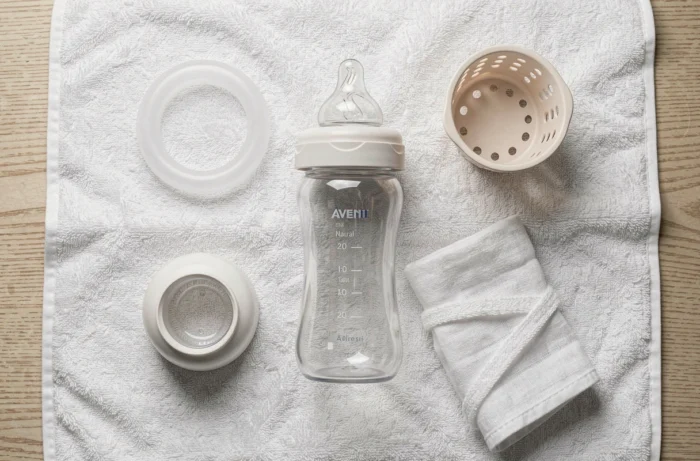
While focusing on Mam versus Avent, the choice of bottle material weighs more on safety than the logo printed on it. All plastic bottles sold in France have been BPA-free for years. However, recent studies show that other bisphenols like BPS can migrate into milk, even from containers labeled “BPA-free”.
Both brands offer glass versions in their range, and it is advisable to lean towards this material if the weight of the bottle is not a concern. Glass does not release microplastics or bisphenols, even with repeated high-temperature sterilization.
- For outings and daycare, plastic (PP) remains more practical due to its lightness and drop resistance
- For feedings at home, a glass bottle from Mam or Avent limits exposure to substances from plastic
- PPSU (premium plastic, translucent amber) offers a compromise: more heat-resistant than standard PP, without BPA or BPS
Rather than exclusively choosing Mam or Avent, one can combine: a glass bottle for home, a lightweight plastic bottle for travel, while keeping the same brand of nipple to avoid disrupting the baby.
Ultimately, the choice between these two brands depends on the current priority. Significant colic and the need for practicality on the go: Mam and its self-sterilizing ventilated base are a good fit. Mixed feeding and the search for a nipple close to the breast: Avent’s Natural Response nipple takes the advantage. In both cases, checking the bottle material and warming method is as important as the brand itself.