Cooking at home every day doesn’t require any special talent or hours of preparation. It’s mostly about a few concrete habits that, once established, transform the perceived chore into a manageable routine. The real barrier isn’t the lack of recipes; it’s often the organization around shopping, food storage, and cooking time management.
Residual Cooking and Energy Savings in the Kitchen
You turn on the oven, let it run until it beeps, then open the door. This habit can be costly. Residual cooking involves turning off the oven or burner a few minutes before the end and letting the accumulated heat finish the job. For a vegetable gratin or a roast chicken, turning off the oven five to ten minutes early doesn’t change the outcome but significantly reduces energy consumption.
The ADEME also recommends systematically covering pots while cooking. A lid placed on a pot of water reduces the time to reach boiling and limits heat loss. This is a gesture that requires no additional equipment.
Another practical tip is batch cooking. When the oven is already hot for one dish, slide a second dish in at the same time. A savory cake next to a roast, roasted vegetables under a chicken. You use the same energy for two results. To delve deeper into this optimized cooking logic, Myn Idee’s tips on Cookinette detail complementary methods that fit well into this approach.

Shopping Management and Fresh Product Storage
Batch cooking gets a lot of attention, but not everyone has Sunday afternoons free to prepare five meals in advance. A more realistic approach: buy versatile raw products that can be used in several recipes throughout the week.
Onions, carrots, potatoes, rice, lentils, and eggs form a base that covers most everyday dishes. With these foods in permanent stock, you limit trips to the supermarket and reduce impulsive purchases of prepared meals.
Refrigerator Temperature and Shelf Life
A technical point is often overlooked: the refrigerator temperature. For optimal storage of fresh products (meats, vegetables, dairy products), the cold zone of the refrigerator should remain around 4 °C. Beyond that, bacteria grow rapidly, and shelf life decreases.
- Raw meats and fish should be placed in the coldest zone (usually the bottom part) and consumed within two days of purchase.
- Fresh vegetables are stored in the vegetable drawer, protected from excessive moisture, by removing plastic packaging that encourages condensation.
- Leftovers should be transferred to closed containers and consumed within three days, without refreezing previously thawed products.
Maintaining the cold chain remains the first anti-waste reflex and the best protection against foodborne illnesses. Santé publique France emphasizes the separation of raw and cooked foods in the refrigerator to avoid cross-contamination.
Basic Utensils and Preparation Before Cooking
You can cook at home every day with very few utensils. The classic trap is accumulating gadgets that take up space and are never used. Three utensils are enough to cover most daily preparations: a good frying pan, a medium-sized pot, and a properly sharpened chef’s knife.
A well-cutting knife halves preparation time. A dull knife requires force, slows down work, and increases the risk of cuts (the blade slips instead of slicing). Investing in a basic sharpener changes the game.
The Mise en Place Method Applied to Everyday Cooking
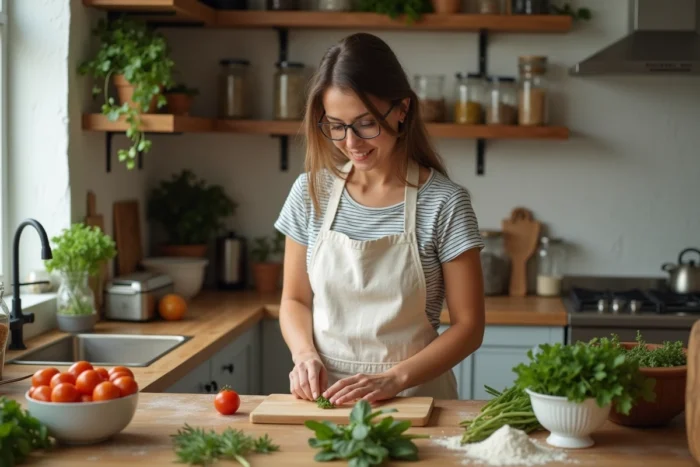
Professionals work with everything ready before turning on the heat. This principle can be adapted flexibly. Before starting a recipe, gather all the ingredients, wash them, chop them, and measure them. This preparation time upfront shortens active cooking time and limits stress.
This habit has another advantage: you immediately spot if an ingredient is missing. It’s better to know before the butter is smoking in the pan than when you’re frantically searching for the onion you forgot to buy.
Reducing Ultra-Processed Foods Without Aiming for Perfection
The PNNS 4 explicitly recommends limiting the consumption of ultra-processed foods and increasing the share of homemade cooking based on raw products. Public health campaigns in France now emphasize “cooking raw” more than simply encouraging the consumption of fruits and vegetables.
In practical terms, replacing an industrially prepared dish with a homemade one, even a simple one, allows you to control the amounts of added salt, sugar, and fats. You choose your oils (canola, olive, walnut), measure the salt, and avoid long lists of additives.
This doesn’t mean cooking everything from scratch every day. On a tired evening, pasta with olive oil, garlic, and parmesan takes less than ten minutes. The goal isn’t perfection but consistency.
- Replacing industrial sauces with homemade dressings (oil, vinegar, mustard) significantly reduces additive intake.
- Preparing a large quantity of roasted vegetables at the beginning of the week allows you to reuse them as a side dish, in salads, or in sandwiches.
- Freezing individual portions of soups or stews offers a quick alternative on nights when time is short.
Feedback varies on the ideal frequency of homemade cooking. Some weeks, you manage five nights out of seven; other weeks, it drops to two. Consistency matters more than intensity. Every homemade meal, even a basic one, is a meal where you control what you eat, and that’s what ultimately changes daily eating habits sustainably.