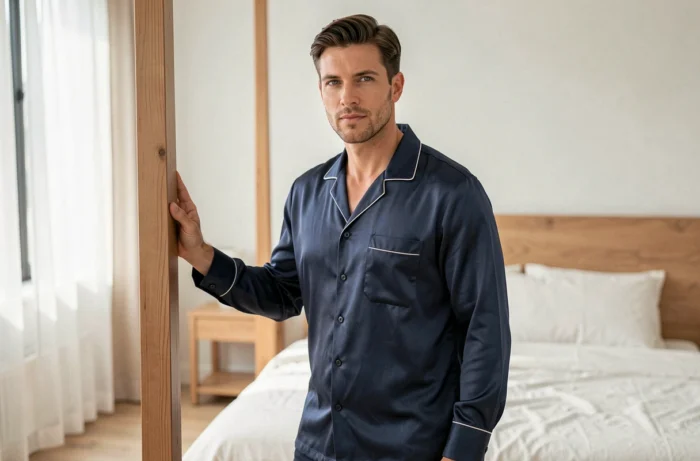
The men’s nightgown is no longer just a provocative wink on a runway. Behind this piece, a measurable market segment is taking shape: that of gender-neutral fashion, which is estimated to be worth $26.53 billion by 2026 with a projection of $49.50 billion by 2033. The men’s nightgown fits into this as a concrete product, driven more by industrial data than by a buzz effect.
Adult Nightwear Market: Where Does the Men’s Nightgown Stand
Recent reports on the global nightwear market now segment products by type (pajamas, nightdresses, robes, loungewear) and by end user (men, women, unisex). The “nightdress” category explicitly includes male and unisex segments, with an analysis horizon extending to 2034.
This segmentation reflects a structural change. The nightgown is no longer solely placed in the women’s sections of catalogs. It appears in mixed categories, indicating that manufacturers and distributors anticipate regular demand, not a fleeting phenomenon.
| Segment | Overall Growth (CAGR) | Categories Including Male Products |
|---|---|---|
| Adult Nightwear (2020-2034) | About 4.3% | Nightdresses, loungewear, robes |
| Gender-Neutral Fashion | Significantly higher than traditional underwear | Nightgowns, dresses, fluid tops |
| Traditional Men’s Underwear | Moderate growth | Boxers, briefs, undershirts |
The contrast between the moderate growth of traditional men’s underwear and the acceleration of gender-neutral fashion explains why brands are repositioning their night collections. The men’s nightgown benefits from this differential in commercial dynamism.
The decision to wear a men’s nightgown is therefore based on an offer that is genuinely diversifying, not just on a militant or editorial discourse.

Men’s Nightgown and Dress Codes: What is Changing in Men’s Fashion
Men’s nightwear has long been centered around cotton pajamas and boxers. The nightgown introduces materials (satin, silk, lace) and cuts (flared, short, fluid) that had no equivalent in men’s wardrobes.
This break is not limited to aesthetics. It is based on a shift in gender codes in fashion, where the boundary between men’s and women’s wardrobes is gradually fading. Recent runway shows from brands like Louis Gabriel Nouchi have showcased men’s lingerie with lace and transparency, normalizing materials once reserved for women’s collections.
Materials and Cuts Defining the Men’s Nightgown
- Satin and silk remain the dominant fabrics, chosen for their fluidity and thermal comfort in warm weather
- Lace appears on borders or inserts, used as a detail rather than as the main material on most men’s models
- Cuts vary between mid-thigh nightshirts and short strap nightgowns, with sizes adapted to male body types (broader shoulders, straight torso)
The choice of cut depends on the use. A satin nightgown with thin straps is closer to casual loungewear. A longer version in silk resembles a reimagined nightdress.
Gender-Neutral and Nightgown: A Fundamental Movement, Not a Provocation
Reducing the men’s nightgown to a provocative gesture ignores market figures. Gender-neutral fashion is growing faster than traditional ready-to-wear, and this differential attracts investments from textile groups.
Brands offering nightgowns for men are not solely targeting a militant niche. They are responding to a demand identified by market studies: male consumers seeking comfort, variety, and nightwear that does not limit itself to shapeless t-shirts.
Persistent Barriers and Real Adoption
Adoption remains uneven across geographical markets. In Western Europe and North America, media visibility (Calvin Klein campaigns, GQ covers) accelerates normalization. In other regions, men’s nightwear remains a very conservative segment.
The main barrier is not price or availability. It is the social perception of the garment. A man wearing a nightgown at home faces no practical obstacles. The resistance comes from the cultural association between nightgowns and femininity, an association that the gender-neutral market is eroding year after year.
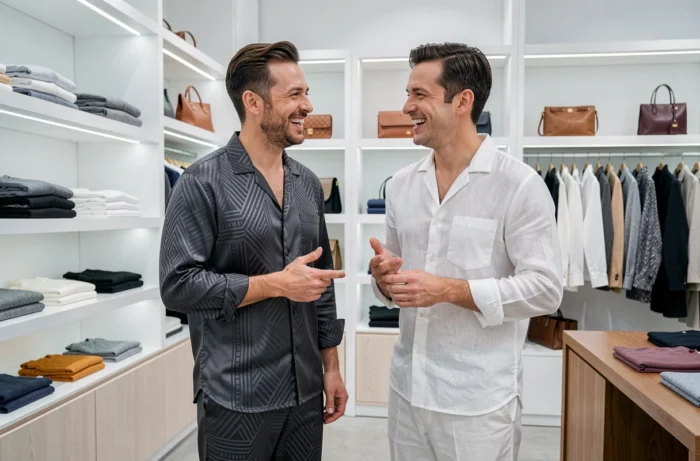
Criteria for Choosing a First Men’s Nightgown
Transitioning to purchase involves considering some concrete parameters, different from those of a classic pajama.
- Size: unisex brands use neutral size charts, but nightgowns designed for men incorporate adjustments at the shoulders and torso. Checking the manufacturer’s size guide avoids disappointments
- Material: synthetic satin offers an accessible entry price, while natural silk provides better thermal regulation for a higher budget
- Care: lace and silk require cold or hand washing. Polyester satin withstands machine washing better, making it more suitable for daily use
- Length: mid-thigh for a bolder style, above the knee for a more gradual approach
Comfort takes precedence over visual boldness for a first purchase. A simple cut in solid satin, without lace, allows one to test the sensation without a too marked break from their habits.
The market for men’s nightgowns is based on measurable fundamentals: growth of the gender-neutral segment, industrial segmentation of nightwear including male categories, and diversification of materials offered by manufacturers. The trend is supported by market data, not just a fleeting fashion effect.