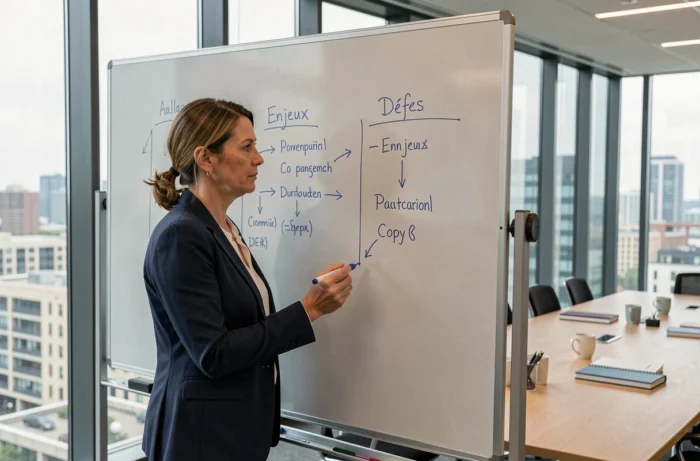
The words “issue” and “challenge” circulate in corporate reports, institutional speeches, and press articles with a frequency that blurs their respective meanings. An issue refers to what can be gained or lost in a given situation. A challenge refers to an obstacle that must be overcome to achieve a result. Confusing the two leads to vague diagnoses and poorly calibrated decisions, whether in project management, negotiation, or public policy.
When mental health shifts from individual challenge to organizational issue
The semantic shift between challenge and issue is not just a matter of dictionary definitions. It plays out concretely in how organizations address their problems. Workplace mental health provides a recent case in point.
For a long time, work-related stress or workload overload was labeled as a “challenge” that each employee had to tackle on their own. Companies offered at best stress management workshops, positioning the difficulty on the individual side.
Recent work on the prevention of psychosocial risks has changed this perspective. According to an article from Juritravail updated in 2026, mental health is now treated as a workplace safety issue, on par with physical risks. This reclassification is not cosmetic: it engages the legal and managerial responsibility of the employer and imposes formalized plans for diagnosis, prevention, and listening.
Understanding the difference between issues and challenges helps to grasp why this shift profoundly alters internal policies. As long as stress remains a challenge, the organization does not need to restructure. Once it becomes an issue, the financial, legal, and human impacts necessitate a rethink of risk management.

Issue or challenge: what the nature of the risk reveals for the company
The confusion between the two terms masks a fundamental difference in risk analysis. A challenge implies an identifiable technical or operational difficulty, with a limited scope. An issue concerns the overall consequences of a situation, whether positive or negative.
Take data security in a company. Implementing a firewall that complies with the latest standards constitutes a technical challenge. It requires time, skills, and a budget. The issue, however, concerns what the company risks losing: the trust of its clients, its regulatory compliance, or even its sustainability in the event of a massive information leak.
Three criteria to distinguish an issue from a challenge
- Temporal aspect: a challenge has a defined horizon (deploying a tool in six months), while an issue persists as long as the structural conditions have not changed (data protection remains an issue even after the firewall is installed).
- Scope of impact: a challenge often concerns a team or a process; an issue affects multiple stakeholders, sometimes the entire organization or sector.
- Reversibility: failing to meet a challenge allows for a different approach next time. Ignoring an issue can lead to consequences that are sometimes irreversible on reputation, finances, or security.
These criteria are not absolute. Field feedback varies on this point, particularly because some situations combine both dimensions. A digital transformation, for example, represents both a technical challenge and a strategic issue for the company.
Why the confusion between issues and challenges weakens decision-making
Labeling an issue as a mere challenge minimizes its impacts. Conversely, turning every operational challenge into an issue unnecessarily dramatizes and paralyzes action. A poorly calibrated analysis directs resources to the wrong place.
In project management, this confusion manifests in the diagnostic phase. If a project manager identifies meeting deadlines as an “issue,” they risk mobilizing disproportionate resources on a problem that is actually an internal organizational challenge. Conversely, if they treat regulatory compliance of a product as a mere challenge, they underestimate the consequences of failure for the entire company.
Strategic issues and operational challenges: two distinct levels of analysis
The Office québécois de la langue française (OQLF) noted that the word “issue” is often used as a synonym for “problem,” “challenge,” or “major concern,” a usage sometimes criticized by several linguists. This linguistic drift is not trivial: it reflects a real difficulty in prioritizing levels of risk within organizations.
In practice, separating these two levels of analysis allows for a structured response:
- Challenges require an action plan with steps, responsible parties, and monitoring indicators. They fall under operational management.
- Issues necessitate reflection on possible consequences, involved stakeholders, and trade-offs to be made. They fall under strategy.
- A single topic can be both a challenge and an issue, but the analysis must address both dimensions separately to avoid blind spots.

Issues and challenges in institutional vocabulary: a persistent blur
The report from the International Labour Organization published in 2026 describes psychosocial risks at work as a “bottleneck” for productivity. The term “socio-economic issue” is explicitly used to distinguish these risks from one-off management challenges. This lexical choice signals a shift in framework: moving from problem-solving to managing systemic impacts.
In the media and corporate communication, the trend goes in the opposite direction. The word “challenge” is appealing because it evokes action and energy, whereas “issue” may seem abstract. The result is a vocabulary that flattens distinctions and complicates analysis for decision-makers as well as the public.
Terminological clarity is not a luxury for linguists. Correctly naming what an organization faces, whether a challenge to overcome or an issue to measure, conditions the quality of the diagnosis and the relevance of the responses provided. A poorly labeled challenge remains a technical problem; a poorly named issue becomes an invisible risk.