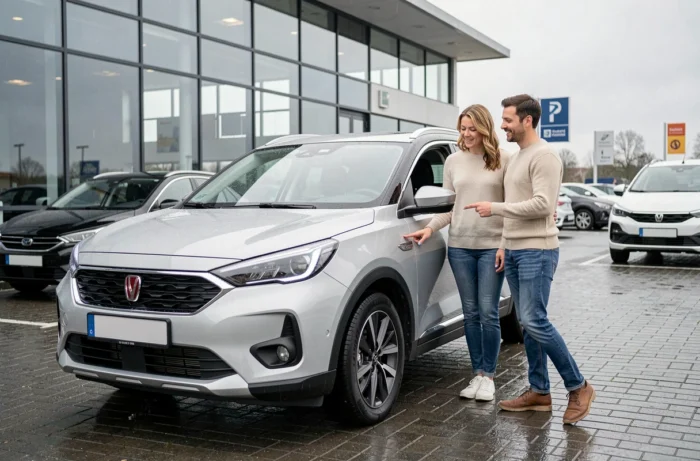
Buying a car in Belgium in 2026 means navigating between an increasing variety of engines, a regional tax system that increasingly impacts the final bill, and a second-hand market undergoing significant changes. Before comparing models, you need to ask the right questions about your actual usage, your overall budget, and the regulatory constraints that apply in your region.
Registration Tax in Wallonia: The Factor Many Discover Too Late
Since July 2025, Wallonia has significantly restructured its registration tax (TMC). The calculation now incorporates CO₂ emissions and the vehicle’s weight much more prominently than before.
In practical terms, a heavy thermal SUV costs significantly more to register in Wallonia than it did two years ago. This reform also affects imported second-hand vehicles, which changes the game for those considering a cross-border purchase or a trade-in of a model from Flanders.
Are you hesitating between two vehicle sizes? Simulate the Walloon TMC before signing. A compact model with low emissions can represent several hundred euros in savings at registration compared to an SUV of equivalent segment. To compare technical specifications and user feedback on different models, specialized platforms exist: https://www.auto-test.be/ notably aggregates detailed reviews that usefully complement manufacturer data.
In Flanders and Brussels, the rules differ, but the trend is the same: heavy and high-emission vehicles are gradually penalized. Check the tax regulations in your region before choosing a model, not after.
Electric Vehicles in Belgium: A Market Driven by Fleets, Not Individuals
The sales figures for electric cars in Belgium are impressive at first glance. In 2025, 100% electric models accounted for about 34.7% of new registrations. The reality is more nuanced.
Of these registrations, the vast majority come from company cars. Only 15,483 new electric vehicles were purchased by individuals in 2025, barely one-tenth of the total new electric registrations. In the first half of 2026, the share of electric vehicles among individual customers exceeds 10% for the first time, compared to 8.9% the previous year.
Why this gap? The purchase price remains the primary barrier. Affordable electric models (under 30,000 euros) are still rare in the Belgian market. Households that make the leap often have a home charging station, a private garage, and predictable daily commutes.
What This Means for Your Choice
If you mainly drive in the city and cover less than 200 km per day, an electric model might be relevant. Check access to a charging station at home or work: this is the factor that conditions daily usability comfort, much more than the theoretical range announced by the manufacturer.
If you do not have this option, a hybrid remains a realistic compromise. Classic hybrid models (non-rechargeable) consume less in the city without requiring any particular infrastructure.
Used or New: The Trap of Total Cost Over Five Years
Comparing only the purchase price is not enough. A second-hand vehicle priced at 15,000 euros can cost more over five years than a new model priced at 25,000 euros if maintenance, fuel consumption, and depreciation are unfavorable.
Here are the items to include in your calculation:
- The TMC and the annual circulation tax, which vary according to the region, engine type, weight, and emissions of the vehicle
- The cost of insurance, often higher on a recent vehicle with significant catalog value
- The actual consumption (not the WLTP value), to be estimated based on your usual trips: city, highway, mixed
- The expected depreciation at resale, particularly strong on first-generation electric models whose range ages poorly
A recent second-hand vehicle with Car-Pass often offers the best cost/reliability ratio. The Car-Pass, a mandatory document in Belgium, certifies the actual mileage and limits the risk of fraud. It is a safety net that not all neighboring markets provide.
Low Emission Zones: Anticipating Traffic Restrictions
Brussels, Antwerp, and Ghent apply low emission zones (LEZ) with progressive restriction schedules. In 2026, certain Euro 5 diesel and Euro 2 petrol vehicles are already banned in the Brussels LEZ.
These restrictions are tightening each year. Buying a diesel vehicle today, even a recent one, carries a risk of accelerated value loss if the next phases exclude its Euro standard from these zones.
- If you regularly drive in Brussels or Antwerp, prioritize a Euro 6d petrol vehicle or newer, a hybrid, or an electric vehicle
- For exclusively rural or highway use, diesel remains competitive in consumption, but its resale value in Belgium is decreasing faster than before
- Check the LEZ schedule for your area before buying: a vehicle banned from LEZ in two years will suddenly lose value
The Specific Case of Resold Company Cars
The Belgian second-hand market is largely fueled by leasing returns. These vehicles, often well-maintained and recent, come to market with high mileage but a documented history. This is an interesting pool for individuals looking for a recent model at a reduced price, provided they check the condition of the tires, brakes, and battery (for hybrids and electric vehicles).
The choice of a car in Belgium depends as much on your region as on your usage. The same model can cost significantly more or less depending on whether you register it in Wallonia, Flanders, or Brussels. Asking these fiscal and practical questions in advance avoids unpleasant surprises once the order form is signed.