
Your teacher salary was supposed to arrive on the 28th of the month, but your account remains desperately empty the next day. This scenario was experienced by several agents of the National Education in 2026. Understanding the payment schedule, identifying the cause of a delay, and knowing what steps to take can help avoid suffering the situation without reacting.
Antepenultimate working day: the rule that sets the teacher’s pay date
The salary of civil servant teachers is paid according to a principle not well known to the general public. The General Directorate of Public Finances (DGFiP) schedules the transfer on the third working day before the end of the month. This day has a complicated name, the antepenultimate working day, but the mechanism is simple: we start from the last day of the month, go back three working days, and obtain the value date of the transfer.
Let’s take a concrete example. In September 2026, the last working day falls on Wednesday the 30th. By going back three working days (Tuesday the 29th, Monday the 28th), we arrive at Monday, September 28 as the transfer date. This logic applies throughout the year, with one exception.
In December, the transfer is advanced by about a week. The closure of the state’s accounting year requires the DGFiP to complete operations earlier. In December 2026, the chosen date is Tuesday, December 22. Questions about teacher pay and salary delays 2026 often arise during this period when the advancement of the transfer surprises agents who had not anticipated it.
The value date of the transfer and the date it appears in your account are two distinct things. Count one to two additional banking days after the official date. If the DGFiP schedules the transfer on a Friday, the credit may not appear until the following Monday or Tuesday. This delay depends on your bank, not the administration.
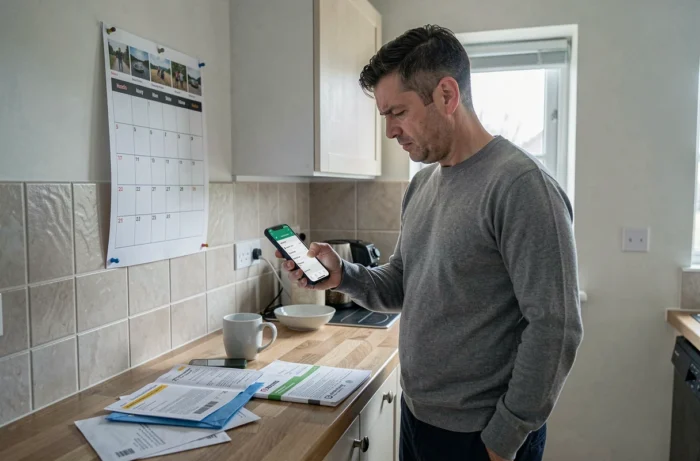
Teacher salary delay: distinguishing banking delay from the real problem
Before you worry, check if the gap between the official date and the appearance of the salary corresponds to the normal banking delay. If your salary consistently arrives two days after the DGFiP date, it is not an administrative delay.
A real delay manifests differently. Have you noticed that some colleagues receive their transfer while you do not? An administrative delay often affects specific profiles: recently transferred agents, contractual employees whose file was not submitted on time, teachers returning from leave or parental leave.
The most common situations include:
- Inter-academic transfer with incomplete file transfer between the HR services of the old and new rectorates
- Status change (from contractual to permanent, or vice versa) during the school year
- Data entry error in the payroll system, particularly regarding the enhanced index or overtime
- Delay in administrative processing during the first assignment of a competition winner
In these cases, the problem does not come from the bank but from the academic management service. This distinction is crucial for directing your complaint to the right contact.
Concrete steps in case of civil servant salary delay
If your salary is not credited within three working days following the official date, a step-by-step approach is necessary.
Start by contacting the personnel management service of your rectorate. Each academy has a dedicated service, sometimes called the division of teaching staff (DPE). A call or an email is often enough to unblock a file awaiting validation.
If the HR service confirms a delay attributable to the administration, be aware that a legal point deserves attention. The rectorate cannot legally grant a salary advance to compensate for a pay delay. This mechanism, contrary to what many believe, does not exist within the usual framework of the National Education. The only available lever remains the acceleration of payment processing by the managing service.
If the delay extends beyond a month, two complementary actions become relevant:
- Send a registered letter to the academy rector to formalize the complaint and create a written record
- Contact a teacher’s union (SNES-FSU, SE-UNSA, SNALC) that can intervene directly with the academic services to expedite the processing of the file
- Contact the mediator of the National Education if no satisfactory response is obtained within a reasonable time

Late payment interest: a little-known right for teachers
Here is an aspect that pay calendars never mention. When a payment delay is attributable to the administration (and not to a banking delay), the public agent can claim late payment interest. This right exists, but it requires demonstrating the harm suffered.
Specifically, if a delay has forced you to pay bank charges, late penalties on a direct debit, or if you have incurred an unauthorized overdraft, these elements constitute documentable harm. Keep your bank statements and any proof of expenses related to the delay.
The request for late payment interest is addressed to the rectorate by registered letter. In practice, few teachers initiate this process, often due to lack of knowledge. The mere mention of late payment interest in a letter often speeds up the processing of the file.
Pay calendar 2026: key dates month by month
Here are the payment dates for civil servants of the National Education for the year 2026, established based on the DGFiP calendar:
| Month | Transfer Date |
|---|---|
| January | Wednesday, January 28 |
| February | Wednesday, February 25 |
| March | Friday, March 27 |
| April | Tuesday, April 28 |
| May | Wednesday, May 27 |
| June | Friday, June 26 |
| July | Wednesday, July 29 |
| August | Thursday, August 27 |
| September | Monday, September 28 |
| October | Wednesday, October 28 |
| November | Thursday, November 26 |
| December | Tuesday, December 22 |
Always add one to two working days for the actual credit to your bank account. This delay varies according to banking institutions and is not the responsibility of the administration.
A one or two-day occasional delay does not justify a formal complaint. However, any delay exceeding a week after the official date deserves to be reported to the managing service of your academy, along with your identification number (NUMEN) and a bank statement attesting to the absence of transfer.