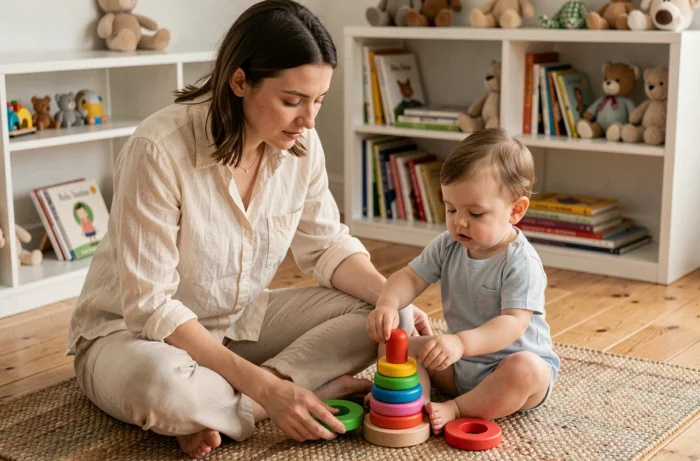
The awakening of the young child refers to the set of sensory, motor, and cognitive acquisitions that develop during the first three years of life. Supporting this awakening does not mean multiplying stimuli, but understanding how a toddler learns and under what conditions their brain makes the most of each experience.
Screen ban before age 3: what the 2025 regulation changes
France has crossed a regulatory milestone regarding screens and young children. An order dated June 27, 2025, published in the Official Journal on July 2, 2025, replaces the old recommendation with a formal ban on screen exposure before age 3 in all collective childcare settings: nurseries, micro-nurseries, and childminders. An active screen in the background is also included.
Since January 2025, the note “no screens before age 3, even in the background” has appeared in the health record given at each birth. This inscription makes it an official public health marker, on par with growth curves or vaccination schedules.
For parents, the practical consequence is direct: screen-free playtime becomes the default setting, both at home and in community settings. Specialized resources on enfant-1.com help identify age-appropriate activities to replace screen time with more enriching interactions.
Free movement and sensory awakening: two pillars of development before age 3
Free movement is based on a simple principle: allowing the child to discover their bodily capabilities at their own pace, without placing them in a position they have not yet mastered independently. A baby placed on their back in an open space will gradually roll over, crawl, sit up, and then stand.
This process of autonomous exploration enhances self-confidence and coordination. It does not require expensive equipment: a firm mat, a few objects of varying sizes, and a secure space are sufficient.
Engaging the five senses daily
Sensory awakening does not rely solely on toys labeled “educational.” Ordinary situations provide rich stimulation:
- Handling different textures (fabric, wood, rubber) helps the child refine their sense of touch and build tactile references.
- Listening to varied sounds (voices, acoustic music, household noises) develops auditory discrimination, which is useful for language acquisition.
- Observing visual contrasts (colored objects, natural light patterns) stimulates the maturation of the visual system during the first months.
The balance between free exploration and calm moments is just as important as the stimulation itself. A child who is overexposed to stimuli may withdraw or become agitated. Respecting their signs of fatigue is part of the support.
Games and awakening activities suitable for the child’s age
Not all games are equal depending on the stage of development. Offering an activity that is too complex frustrates the child, while a game that is too simple quickly loses their interest. The challenge is to align with their current zone of progression.
Before 6 months
The newborn primarily explores through sight and bodily contact. High-contrast mobiles, softly sung nursery rhymes, and skin-to-skin contact are the best awakening activities at this age. Light or sound electronic toys offer little compared to direct human interaction.
From 6 to 12 months
The child begins to grasp, manipulate, and bring objects to their mouth. Stacking toys, lightweight balls, and containers to fill and empty engage hand-eye coordination. This is also the period when language preparation begins: naming the objects being handled and describing ongoing actions helps the child associate sounds with meanings.
After 12 months
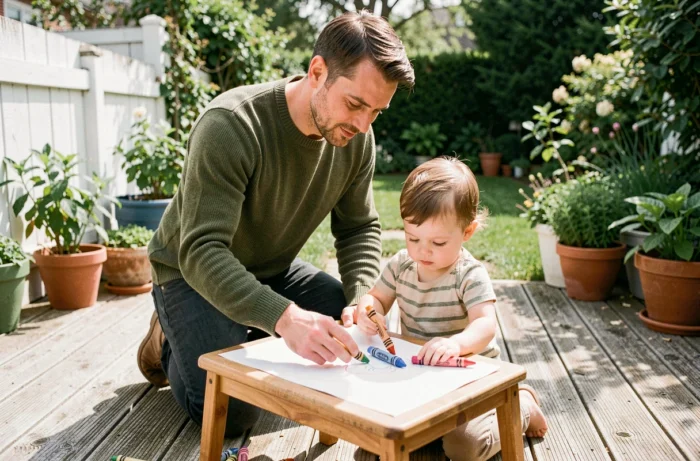
Once walking is acquired, a vast field of physical exploration opens up. Activities involving pouring (water, sand, seeds under supervision), free drawing, and imitation games (play kitchen, phone, doll) allow the young child to develop their autonomy and symbolic thinking.
The role of parents in awakening: attentive presence rather than overstimulation
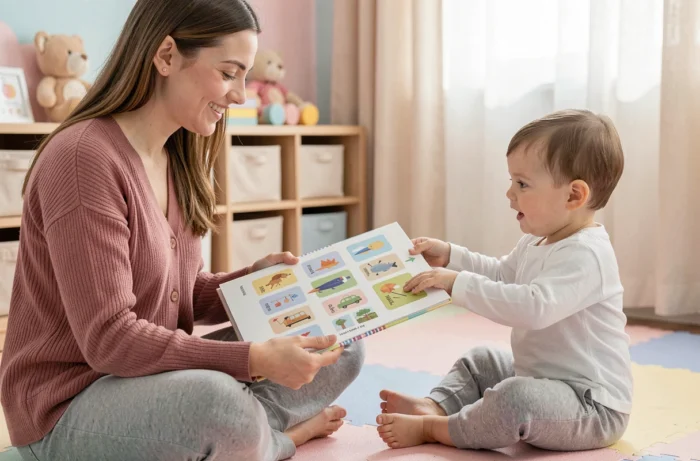
Recent research in developmental neuroscience shows that the quality of parental presence influences a child’s cognitive development more than the quantity of toys or activities offered. A parent who observes, comments, and responds to their child’s initiatives creates a natural learning environment.
The “3-6-9-12” rule, promoted by French public health authorities, provides concrete guidelines for structuring activity times by age group. It particularly recommends screen-free periods in the morning, during meals, and before bedtime, three moments when direct interaction is most beneficial.
- In the morning, a period of free play with simple objects helps the child start the day with active exploration.
- During meals, conversation (even one-sided with an infant) nourishes the language bath.
- In the evening, a calm routine (reading a picture book, singing a song, cuddling) prepares for sleep without resorting to a screen.
Supporting awakening mainly involves protecting the conditions under which the child learns naturally. Securing the space, limiting digital disruptions, responding to the child’s signals, and allowing them time to explore independently remain the most effective strategies, well before purchasing specialized toys or enrolling in dedicated workshops.