Converting 50 cl to ml boils down to answering a single question: what factor separates centiliters from milliliters in the metric system? The answer lies in one operation, but dosage errors related to this conversion remain common. This article measures the discrepancies between different conversion methods, identifies documented pitfalls, and provides a practical reference table for use in both the kitchen and the laboratory.
Conversion factors between liters, centiliters, and milliliters: the comparison table
The metric system is based on multiples of 10. For liquid volumes, three units coexist daily: the liter, the centiliter, and the milliliter. Here are the exact relationships between these units.
| Conversion | Multiplicative factor | Example |
|---|---|---|
| Liter → centiliter | × 100 | 1 L = 100 cl |
| Centiliter → milliliter | × 10 | 1 cl = 10 ml |
| Liter → milliliter | × 1,000 | 1 L = 1,000 ml |
| Milliliter → centiliter | ÷ 10 | 500 ml = 50 cl |
| Centiliter → liter | ÷ 100 | 50 cl = 0.5 L |
The line concerning the conversion of 50 cl to ml reads as follows: 50 cl × 10 = 500 ml. The factor of 10 between centiliters and milliliters is the only one to remember for this calculation.
This table highlights a point often underestimated: the factor between liters and centiliters (× 100) differs from that between centiliters and milliliters (× 10). Confusing these two factors is the most common source of error.

Chain conversion error: why the transition from L to cl to ml is so misleading
When a recipe or dosage sheet indicates a volume in liters and the measuring cup displays milliliters, the temptation is to convert in two steps: liter to centiliter, then centiliter to milliliter. This chain process multiplies the chances of making mistakes regarding the factor applied at each stage.
Let’s take a concrete example. Converting 0.5 L to ml can take two paths:
- Direct path: 0.5 L × 1,000 = 500 ml (one operation, one factor)
- Chain path: 0.5 L × 100 = 50 cl, then 50 cl × 10 = 500 ml (two operations, two distinct factors)
- Typical error on the chain path: applying × 10 at both steps instead of × 100 then × 10, resulting in 5 cl then 50 ml, which is ten times less than the actual volume
Chain conversion increases the risk of error regarding the factor. In professional cooking or cosmetics, a dosage that is ten times too low or too concentrated may sometimes go unnoticed visually, but it alters the final result.
For simple conversions like 50 cl to ml, the direct path (multiplying by 10) is sufficient. However, as soon as a transition through the liter is required, favoring the single factor (L → ml = × 1,000) reduces the risk of error to a single operation.
Centiliters and milliliters in cooking: where each unit actually appears
French recipes do not use centiliters and milliliters interchangeably. Each unit has a dominant area of use, and understanding this distribution avoids unnecessary back-and-forth between units.
The centiliter dominates beverages and large liquid volumes
Bottles of water, juice, cream, or milk almost always display their capacity in centiliters. A carton of cream indicates 20 cl. A standard bottle of wine contains 75 cl. The centiliter is the labeling unit for common liquids in France.
Cocktail recipes also work in centiliters: 4 cl of rum, 2 cl of syrup, 10 cl of juice. The reason is practical: the numbers remain small and readable.
The milliliter dominates pastry and precise measurements
Whenever a recipe requires precision, the milliliter takes over. A pastry cream requires 250 ml of milk. A sugar syrup is measured at 150 ml of water. Measuring cups graduated in milliliters offer a finer reading than those graduated in centiliters.
A measuring cup graduated in ml allows for a more precise reading than in cl, especially for small quantities. Below 5 cl (50 ml), the graduation in centiliters lacks resolution: each mark represents 10 ml, which leaves a notable margin of error for volumes of 15 or 25 ml.
Volume in milliliters and weight in grams: the confusion that skews measurements
Many recipes mix milliliters and grams as if these two measurements were equivalent. For pure water, the approximation works: 500 ml of water weighs about 500 grams. This correspondence comes from the historical definition of the kilogram, initially based on a liter of water at a specific temperature.
For any other liquid, this equivalence no longer holds. Oil, less dense than water, is significantly lighter at equal volume. Thick fresh cream, honey, or maple syrup each have different densities. Applying the rule “1 ml = 1 g” to these ingredients introduces a dosage discrepancy that affects the recipe’s outcome.
The density of the liquid determines its actual weight for a given volume. When a recipe indicates 50 cl of cream, the volume is 500 ml, but the weight will not be 500 g. Only water (and to a lesser extent milk, which has a similar density) allows for direct interchangeability between milliliters and grams.
Direct method to convert 50 cl to ml without error
Three points are enough to lock in the conversion and avoid any confusion:
- The factor between centiliters and milliliters is always 10. To convert from cl to ml, multiply by 10. For the reverse path, divide by 10
- Do not chain two conversions when one is sufficient. If the starting point is in centiliters and the destination is in milliliters, one calculation closes the subject
- Never confuse volume (ml) and weight (g) except for water. For any other liquid, check the density before interchanging the units
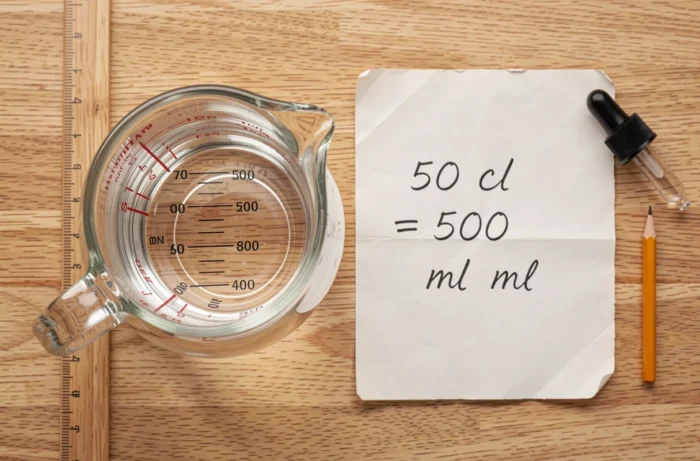
50 cl = 500 ml. The factor of 10 between these two units is the only element to memorize. The rest, the distinction between the use of centiliters and milliliters, vigilance on chain conversions, the density-volume trap, falls under the application context. But the calculation itself never changes.