Insulating your walls from the inside without losing living space is the promise of thin insulation boards. The market today offers solutions ranging from rigid polyurethane to aerogel-based panels, with considerable performance differences from one product to another. Since January 1, 2026, the regulatory framework has changed: interior wall insulation is no longer eligible for the “by gesture” pathway of MaPrimeRénov’, which redefines the selection criteria for individuals.
Required thermal resistance and thin insulation: a persistent misunderstanding
The first reflex before choosing a thin interior insulation board is to check the targeted thermal resistance. For interior walls, the minimum threshold set by MaPrimeRénov’ as part of a major renovation is R ≥ 3.7 m².K/W. This figure conditions access to financial aid, including energy savings certificates (CEE).
The problem is that no thin insulation installed alone can reach this threshold. ADEME reaffirmed in December 2025 that thin insulations cannot replace traditional insulation. They are considered as complements, useful for limiting thermal bridges or locally improving comfort, not as the primary material.
This does not mean that thin boards are useless. However, it is essential to distinguish between two categories of products that are often confused: multilayer reflective thin insulations (a few millimeters thick) and rigid low-thickness panels (polyurethane, polyisocyanurate, aerogel) that offer real thermal resistance in a reduced footprint. It is this second category that deserves to be compared in the context of searching for a thin interior insulation board on Blogsplot suitable for a renovation project.
Thermal conductivity of thin insulations: lambda as a sorting criterion
Thermal conductivity, denoted λ (lambda), measures how easily a material allows heat to pass through. The lower the lambda, the more efficient the insulation is at the same thickness. This is the decisive parameter for comparing thin boards with each other.
Low lambda materials available in rigid panels
- Polyurethane (PUR) has one of the lowest lambda values among common insulations. It allows for achieving a correct thermal resistance with a significantly reduced thickness compared to mineral wool.
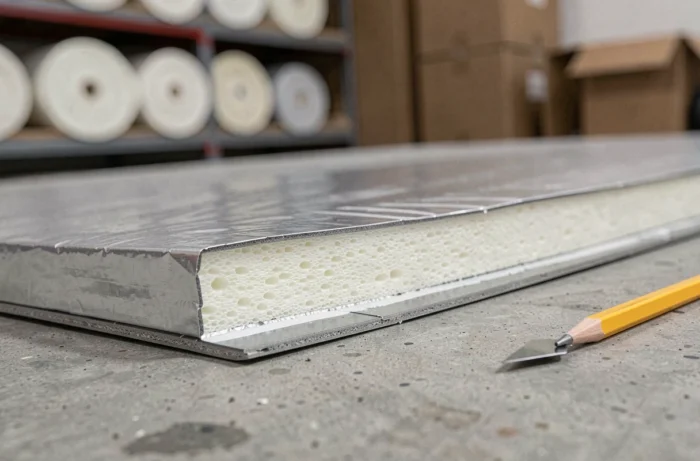
- Polyisocyanurate (PIR) operates on the same principle as PUR, with better fire resistance. It is often offered in sandwich panels with integrated facing.
- Silica aerogels represent the most efficient solution in terms of thickness/thermal resistance ratio. Their cost remains significantly higher than other options.
Mineral wools (glass, rock) and bio-sourced insulations (wood fiber, hemp) offer good overall performance, but their higher lambda requires thicknesses incompatible with a search for minimal bulk. They do not fall under the “thin insulation” category in the strict sense.
Lambda is not everything
A low lambda does not guarantee good long-term performance. Polyurethane, for example, sees its performance slightly degrade over time if the panel is not properly protected from moisture. Vacuum panels (VIP) offer exceptional lambda, but the slightest perforation of the envelope drastically reduces their effectiveness.
The actual thermal resistance also depends on the implementation: poorly treated joints, approximate cuts, or lack of vapor barrier can negate the benefits of a material that performs well on paper.
Thin insulation and fire safety: a consideration not to ignore
Synthetic insulations with low thickness (polystyrene, polyurethane) pose a long-identified problem for indoor use. In case of fire, they emit toxic fumes. This is why several technical sources recommend reserving polystyrene for external insulation or floors.
Polyisocyanurate stands out for its better fire reaction than conventional polyurethane, which explains its increasing presence in thin interior insulation solutions. Silica aerogels also show good fire behavior, but field feedback varies on their long-term durability in humid configurations (bathrooms, basements).
Before installing a thin insulation panel on an interior wall, checking its fire classification (Euroclass) and compatibility with the existing substrate remains a step that many individuals overlook.
Thin interior insulation board and financial aid in 2026: what has changed
Since 2026, interior wall insulation no longer benefits from the “by gesture” pathway of MaPrimeRénov’. Only a major renovation allows for obtaining funding, which implies combining several work items (insulation, ventilation, heating).
For a thin insulation to be considered in a financial aid application, it must be combined with a certified traditional insulation, with the entire assembly meeting the required resistances. A low-thickness polyurethane panel installed alone on a wall generates neither a bonus nor CEE, even if it objectively improves comfort.
This regulatory constraint directs the choice towards composite systems: a layer of traditional insulation (rock wool, wood fiber) complemented by a thin panel to gain a few points of thermal resistance without encroaching too much on the interior volume. The combination of traditional insulation + thin panel is the only configuration eligible for aid when working with low thickness.
Acoustic comfort and hygrometric regulation: the blind spots of thin insulation
Thin synthetic insulations (polyurethane, polystyrene) are poor in acoustic insulation. If your walls face a busy street or a noisy neighbor, a few centimeters of PUR panel will provide almost no protection against airborne noise.
Bio-sourced insulations, on the other hand, offer better humidity regulation and superior thermal phase shift (better summer comfort). But their necessary thickness excludes them from the “thin” category.
This compromise between thermal performance, bulk, acoustic comfort, and hygrometric regulation has no perfect solution. Choosing a thin interior insulation board involves accepting limitations on at least one of these criteria and clearly identifying them before starting work.