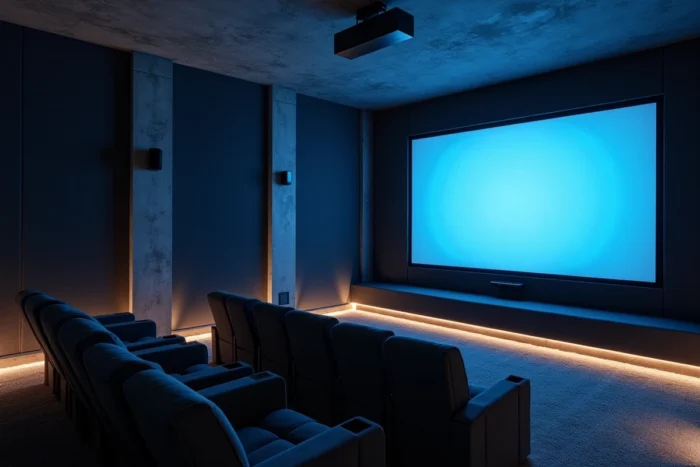
A closed home cinema, soundproofed, accumulates heat and CO₂ much faster than a typical living room. The ventilation of a home cinema influences both the respiratory comfort of the viewers, the lifespan of the projector, and the control of background noise. Measuring these interactions allows for the selection of an appropriate system rather than enduring costly compromises later on.
Thermal load and CO₂ in a closed home cinema
A 4K projector dissipates a significant amount of heat, to which the multi-channel amplifier, active speakers, and the presence of several viewers contribute. In a sealed room treated as a “box within a box” for sound insulation, no natural ventilation compensates for these inputs.
The RE2020 imposes very low air permeability thresholds for new constructions (for example, 0.12 m³/h/m² for a single-family home). A dedicated room in this type of building thus becomes significantly more airtight than in typical renovations. Without mechanical extraction, the CO₂ concentration rises within a few tens of minutes, causing drowsiness and headaches even before the end of the film.
The INRS recommends a fresh air supply of at least 50 m³/h per occupant for closed spaces with intensive use. Transposed to a room accommodating four to six people, this value gives a minimum flow rate that far exceeds what a simple passive grille can provide. A comprehensive guide on ventilation for a home cinema details the flow rates to be expected based on the area and the number of occupants.
| Parameter | Non-ventilated room | Room with double flow MVHR |
|---|---|---|
| Temperature after 2 hours of projection | Marked increase (several degrees above comfort) | Stable, close to the setpoint |
| CO₂ level after 2 hours (4 occupants) | Quickly exceeds the discomfort threshold | Maintained below the recommended threshold |
| Background noise from the HVAC system | None (but thermal discomfort) | Variable depending on sizing (target NC 20 to 30) |
| Projector lifespan | Reduced by ambient overheating | Preserved thanks to controlled temperature |

Background noise and ventilation: finding the acoustic balance
The acoustics of a private cinema room are measured in NC (Noise Criteria). A certifiable Dolby Atmos reference room aims for an NC of 20 or lower. A family use tolerates an NC around 30. The ventilation system is often the primary source of residual noise in the room.
A wall-mounted split air conditioner, even in silent mode, generates a perceptible airflow that exceeds the NC 20 threshold. In contrast, a ducted system with sound-attenuated ducts and low-velocity outlets can fall below this threshold. The difference between the two approaches hinges on three technical points:
- The air velocity in the ducts: the more generous the cross-section, the more the flow passes without turbulence or whistling. Undersized ducts negate the advantage of a silent unit.
- The vibratory decoupling between the outdoor unit (or air handling unit) and the room structure. Vibration isolation mounts and flexible sleeves cut off solid transmission.
- The placement of return and supply outlets: oriented towards the seating areas, they create a perceptible flow. Offset towards the ceiling or the back, they circulate air without the viewers feeling the draft.
Undersizing the air distribution network to reduce costs forces the unit to run at full capacity continuously, which increases noise. A properly sized network operates at partial load most of the time, thus more quietly.
Double flow MVHR or ducted with air conditioning: comparison for home cinema
Two architectures are common in dedicated home cinema projects. Each meets a different need, and confusing them leads to sizing errors.
Double flow MVHR only
It renews the air and recovers some of the heat extracted to preheat the incoming air. It is sufficient in rooms where the thermal load remains moderate (few devices, short sessions, temperate climate). Its main advantage: it manages air renewal without adding refrigerant.
Its limitation appears as soon as the heat generated by the projector and amplification exceeds what the heat exchanger can absorb. In this case, the temperature rises despite the air renewal.
Ducted with dedicated network
A ducted system combines active air conditioning (heating and cooling) and air renewal via a network of ducts. It manages thermal peaks during long summer sessions and allows for fine temperature regulation. The technical room (outdoor unit, air handling unit) is placed outside the room, eliminating any direct sound source in the listening space.
The additional cost compared to a double flow MVHR alone is notable, but the ducted system remains the reference for frequently used rooms with high-brightness projectors and multi-channel amplification.
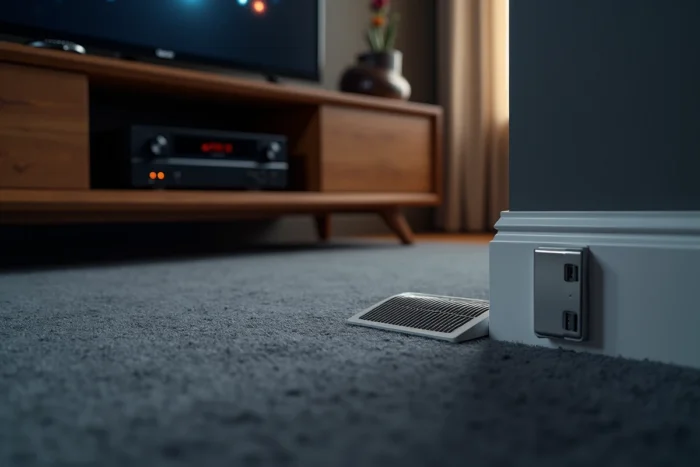
Overheating of equipment: what ventilation concretely protects against
A projector operates with a lamp or laser that generates considerable internal heat. The fan integrated into the device expels this heat into the room. If the ambient temperature rises, internal cooling becomes less effective: the projector reduces its brightness (forced eco mode) or triggers a safety shutdown.
The same mechanism applies to power amplifiers. A multi-channel amplifier operating in a high-temperature room sees its distortion increase and its thermal protection activate, cutting off the sound during a session.
Maintaining the room at a stable temperature through appropriate ventilation prolongs the lifespan of these components and avoids interruptions. This is a direct economic argument: replacing a projector lamp costs more than proper air distribution sizing.
The ventilation of a home cinema is not just an accessory comfort. It determines the perceived acoustic quality, the longevity of the equipment, and the ability to hold a two-hour session without the room becoming uncomfortable. The choice of system is made before the installation of the partitions, not after.