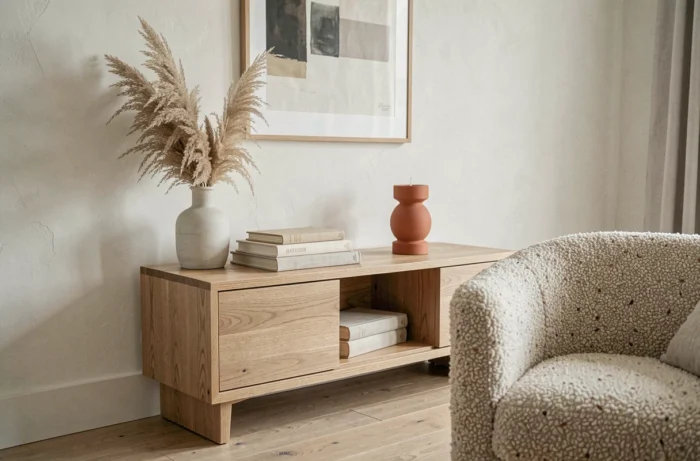
The interior decoration market in France is undergoing a rapid renewal phase. The trends that shaped individuals’ choices two years ago (accent walls, total Scandinavian look, dominant white) are giving way to more assertive approaches, driven by professionals and echoed by the specialized press. Understanding these movements allows for making trendy decoration choices that stand the test of time, rather than following trends that are already declining.
Colour drenching: the technique redefining the use of color in interior decoration
The accent wall, long presented as the safe solution for introducing color into the home, is losing ground to a radically different approach. Colour drenching involves applying a single shade from floor to ceiling, including moldings, door frames, baseboards, and even radiators.
This technique creates a visual immersion effect that alters the perception of volumes. A room treated with drenching appears more cohesive, more enveloping. Interior architects recommend it for living spaces where a marked atmosphere is desired without multiplying decorative elements.
Specialized catalogs and portals like ma-deco-maison.com help identify color and furniture combinations suited to this type of color approach before making purchases.
A variant is also starting to appear in recent projects: double drenching, which combines two colors in immersion within the same space. The principle remains the same (total saturation), but the interplay between two complementary or contrasting shades adds a graphic dimension. Feedback from the field varies on this point: some professionals believe that double drenching works best in large rooms, while others successfully apply it in narrow entries or hallways.
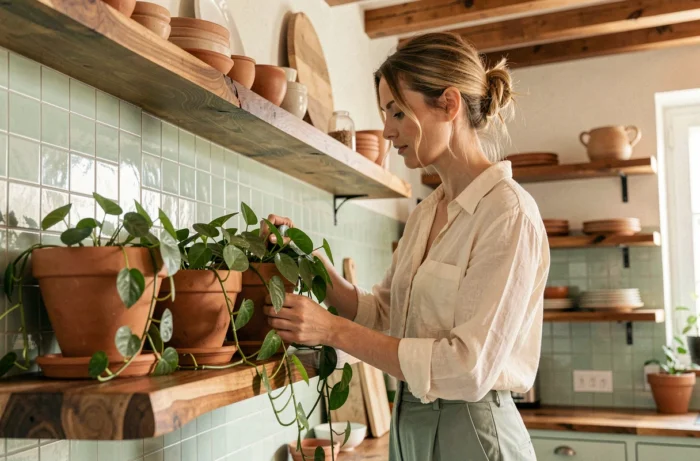
Warm grays and greiges: why cool neutrals are disappearing from trendy interiors
Very cool whites and “clinical” grays that have dominated interiors for about a decade are giving way to warm neutrals, particularly warm grays and greiges. This shift is part of a broader movement described as “discreet luxury,” where the quality of materials and comfort take precedence over spectacular visual effects.
Greige (a contraction of gray and beige) serves as a versatile base. It adapts well to a living room, bedroom, or kitchen and supports various combinations with wood, linen, natural stone, or brushed metal.
This turn towards softer tones has a direct consequence on the choice of furniture and textiles. An anthracite sofa that seemed neutral in a cool white interior may appear too harsh in a greige space. Matte fabrics, boucle textures, and satin finishes are taking precedence over lacquered surfaces or chrome metals.
Adapting lighting to new palettes
The shift to warm neutrals renders some lighting choices obsolete. Cold color temperature bulbs (above 4,000 K) create a visible mismatch with greige walls or warm woodwork. Customizable lighting atmospheres are becoming a full-fledged decorative lever, rather than just a functional complement.
The current trend favors sculptural lamps, which play a dual role of lighting and decorative object. Placed on a console or suspended above a table, they replace standard ceiling lights and allow for modulation of light intensity according to the times of day.
Living room and living space decoration: the structuring choices to make first
Many decoration errors stem from a reversed decision order. People choose cushions, candles, or frames before deciding on the three elements that truly determine the atmosphere of a living space.
- The flooring sets the overall tone: a light oak floor leans towards a Scandinavian or Japandi ambiance, a polished concrete effect tile pushes towards industrial, and a terracotta floor anchors a Mediterranean style. Changing the floor transforms a space more than any accessory.
- The sofa defines circulation and perceived proportions of the living room. Its volume, color, and positioning (against a wall, as a central island, in an L-shape) condition everything else in the layout.
- The main lighting (pendant, floor lamp, wall sconces) establishes the reference lighting atmosphere. Accent lamps then come in to modulate, not compensate for a poor initial choice.
Once these three elements are established, decorative additions (textiles, wall art, plants, objects) come to dress a frame that is already coherent. Decorating without first defining the floor, seating, and lighting is akin to dressing a silhouette without knowing the cut of the garment.
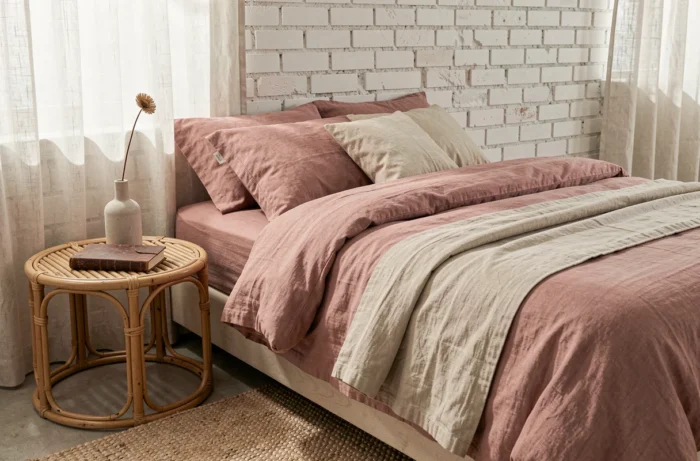
Materials and textures: what distinguishes a current interior from a dated one
Melamine chipboard furniture with a glossy finish, ubiquitous in the 2010s, immediately dates an interior. The materials that characterize current decoration projects share a common point: they prioritize visible texture and touch over smooth surfaces.
Solid or veneered wood with visible grain, caning, rattan, travertine, terrazzo, and artisanal ceramics are making a comeback in kitchens, bathrooms, and living spaces. These materials provide visual depth without needing to accumulate decorative objects.
Mixing textures without overloading the space
The layering of textures (a boucle wool rug on raw wood flooring, a linen cushion on a corduroy sofa) creates relief and warmth. The limit is beyond three or four different textures in the same visual field: beyond that, the effect becomes cluttered.
For a medium-sized living room, combining a smooth textile (cotton, silk), a structured textile (linen, boucle), and a hard material (wood, stone, matte metal) is enough to produce a balanced composition. Each additional element should replace an existing one, not add to it.
Trendy decoration relies less on accumulation and more on the coherence of foundational choices. An interior with three correct decisions (a bold color palette, appropriate lighting, textured materials) produces a more refined result than a space filled with trendy accessories. It is better to invest in the foundations than to multiply decorative layers.