
The oak gall regularly comes up in discussions among gardeners and walkers, often accompanied by a question: can these growths on leaves or branches affect human health? The topic deserves to be examined based on available data, distinguishing between documented risks and confusion with other biological agents related to the oak.
Oak gall and human health: what medical data says
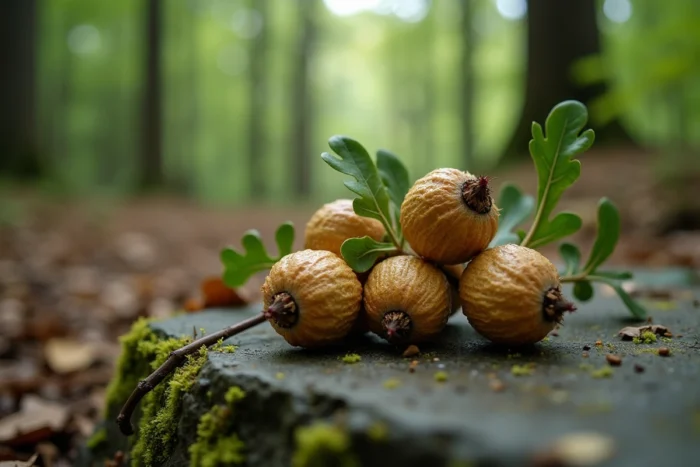
The starting point for any serious analysis remains the medical literature. No cases of serious human infection related to oak galls have been documented in publications accessible in France. Galls are plant growths caused by the laying of eggs by insects from the Cynipidae family: the female gall wasp pierces the oak’s tissues, deposits her eggs, and injects chemical substances that alter the tree’s cellular development.
The result is a plant structure, not a pathogenic agent. The gall contains neither a toxin transmissible to humans nor an infectious microorganism identified as dangerous. Skin contact with a gall does not cause any specific allergic reaction recorded.
To delve deeper into the issue of oak gall in humans, one must therefore look elsewhere for the origin of persistent fears.
| Agent related to oak | Nature of risk to humans | Documented cases |
|---|---|---|
| Oak gall (Cynipidae) | No specific infectious or allergic risk | No serious cases recorded |
| Oak pollen | Seasonal respiratory allergy | Frequent, well documented |
| Oak processionary caterpillar | Contact dermatitis, respiratory issues | On the rise, reported by ARS |
| Ticks (found on oak) | Lyme disease, encephalitis | Active monitoring in France |
Processionary caterpillars and pollen: the real threats of the oak
The confusion between galls and health hazards is partly explained by the coexistence, on the same tree, of very real risks that are unrelated to galls. The oak processionary caterpillars are the first example.
The ARS Bretagne has issued a call for vigilance regarding the recent increase in outbreaks of oak processionary caterpillars. Their stinging hairs cause redness, skin rashes, and, in some cases, respiratory difficulties. These symptoms are sometimes wrongly attributed to other elements present on the oak, including galls.
Oak pollen represents another factor of confusion. Released in spring, it triggers allergic rhinitis and conjunctivitis in sensitive individuals. When a walker develops symptoms after contact with an oak bearing galls, the causal attribution often occurs by visual proximity rather than by diagnosis.
Contact dermatitis: a distinct mechanism
Some individuals report irritations after handling galls. These reactions generally fall under non-specific contact dermatitis, a skin mechanism triggered by repeated friction or contact with various plant materials. Sap, fragments of bark, or insect residues present on the gall can irritate sensitive skin without any toxicity specific to the gall.
- Contact dermatitis manifests as localized redness and itching, which disappear without specific treatment within a few hours
- Washing hands with soap and water after handling plants is sufficient to prevent this type of reaction
- Individuals suffering from eczema or atopic skin are more prone to these irritations, regardless of the plant handled
Why the myth of the dangerous gall persists
The visual aspect of galls plays a decisive role in the persistence of this belief. A spherical growth, sometimes reddish, attached to an oak leaf instinctively suggests a pathology. The abnormal appearance of the gall suggests a danger that does not exist from a medical standpoint.
The terminology amplifies the phenomenon. The word “gall” is phonetically close to “scabies,” the skin parasitic disease caused by a mite. This phonetic proximity is enough to maintain the confusion, even though the two phenomena have absolutely nothing in common: human scabies is caused by Sarcoptes scabiei, a microscopic mite that burrows under the skin.
A classic cognitive bias
The mechanism at work is a correlation bias. A walker observes galls on an oak, then feels an itch (caused by a mosquito, a nettle, heat) and establishes a cause-and-effect link. Without a medical diagnosis, the attribution remains unverifiable but is transmitted orally.
Gardening forums and Facebook groups amplify this cycle. A question posed in a group is enough to reignite the discussion, and responses often mix galls, processionary caterpillars, and ticks in the same thread, blurring the boundaries between documented risks and assumptions.

Oak gall: the only cases where vigilance is warranted
The gall itself does not warrant any particular health precautions. However, the tree bearing galls may also host processionary caterpillars, and it is this coexistence that calls for real attention.
- Before touching an oak bearing galls, check for the absence of characteristic white silky nests of processionary caterpillars on the trunk and lower branches
- During the pollination period (spring), individuals allergic to oak pollen should limit their exposure, regardless of the presence of galls
- After a walk in an oak forest, inspect the skin for ticks, which pose a proven health risk unrelated to galls
The impact of the gall remains limited to the tree itself. The oak is not in vital danger: galls alter its aesthetic appearance but do not compromise its survival. Gall wasps are part of the forest ecosystem and contribute to the local food chain, as galls also harbor parasitoids and secondary predators.
The oak gall does not appear on any list of health risks established by French health authorities. The few reported skin irritations after contact fall under generic mechanisms common to handling many plants. The real subject of vigilance around the oak has a specific name: the processionary caterpillar, whose outbreaks are increasing and whose effects on health are well documented.