Choosing your clothes in 2026 is no longer just about following the fashion shows. A French legislative reform changes the game: a textile bonus-malus system now penalizes disposable items, while the mandatory display of the country of manufacture next to the price will come into effect in September 2026. These two measures concretely push towards smaller wardrobes, composed of strong and durable pieces.
Textile bonus-malus and transparency: what changes in your wardrobe
The malus applied per textile piece starts between €0.25 and €12 in 2026, with a planned gradual increase until 2030. Ultra-cheap fast fashion clothing becomes mechanically less competitive. For your style, the consequence is direct: it’s better to have three well-chosen pieces than a dozen interchangeable basics.
Starting from September 1, 2026, sales sites will have to display the place of manufacture in a font size at least equal to that of the price, right next to it. This transparency makes sourcing visible at a glance. You will know if your dress was made in Portugal or Bangladesh even before clicking “add to cart”.
This double regulatory constraint favors brands that focus on quality craftsmanship and traceability. In practice, this encourages prioritizing pieces with a true stylistic stance, those that discover fashion on Maison de Mode allows you to explore season after season, rather than accumulating impulsive purchases.
Fluid silhouettes and wide pants: the trendy cuts to master
Have you noticed that silhouettes have significantly relaxed in recent seasons? The long fluid dress, back on the runways of Milan and Paris, embodies this direction. Inspired by the poetcore movement, it plays with lightweight materials, generous lengths, and bold colors.
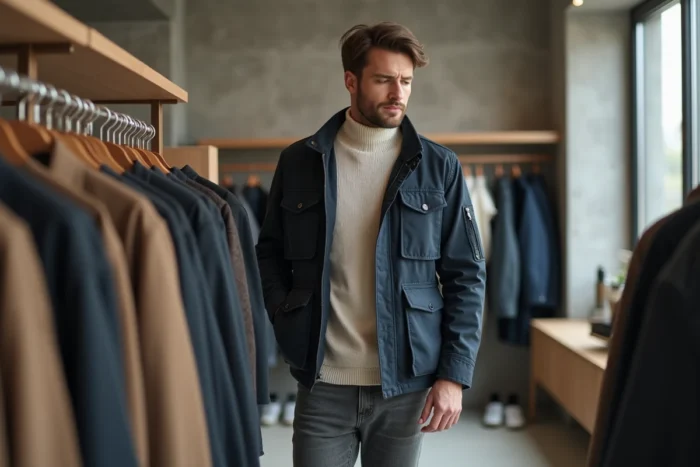
The structured wide pants replace the slim as the base of the wardrobe. High waist, ample fall, sharp cut: it creates an outfit that is both comfortable and elegant. Paired with a fitted top or a tucked-in shirt, it gives a constructed look without apparent effort.
The coordinated set (matching top and bottom, same fabric, same shade) simplifies the composition of a complete look. It’s a practical formula for those who want a strong visual impact without spending twenty minutes in front of the mirror. The key: choose a set whose cut you like regardless of the trend, because you will wear it well beyond a season.
Fashion colors 2026: building a personal palette
The color trends of the season oscillate between intensity and natural tones. Orange, bright pink, yellow, olive green, sky blue: the palettes are varied, but the trap would be to adopt all the trendy shades without coherence.
A more effective approach is to choose two or three strong colors that work together and with the basics already present in your wardrobe. For example:
- An olive green easily pairs with off-white, beige, and black, making it very versatile for everyday wear
- A sky blue works particularly well with raw denim and natural leather accessories
- A bright yellow can serve as a statement piece (a bag, a short jacket) without imposing an entire monochrome outfit
The reflex to avoid: buying a garment in a trendy color without checking that it fits with what you already own. A unique style relies on a coherent palette, not on the accumulation of trendy shades.
Color combinations that last several seasons
Some combinations stand the test of time because they rely on natural contrasts. The duo of navy and terracotta, for example, works well in both winter and summer depending on the chosen materials. Similarly, the combination of black and sage green remains readable without being mundane.

Expressive accessories and details: where to focus your investment
Rather than renewing an entire wardrobe, a well-chosen accessory is often enough to modernize an outfit. Brooches, sculptural jewelry, and geometric-shaped bags mark the 2026 season. These are pieces that transform jeans and a t-shirt into a constructed look.
Focusing your budget on one or two quality accessories allows you to evolve your style without multiplying clothing purchases. A leather bag in a bold color, a crafted belt, or a pair of architectural earrings create a focal point that draws the eye.
Why this choice over yet another trendy top? Because an accessory can be worn with dozens of different outfits. Its cost per use is much lower than a garment worn two or three times before being forgotten at the back of the closet.
Minimalist or statement shoes: how to decide
Two directions coexist this season. Minimalist shoes (flat sandals, sleek loafers) extend the fluid silhouette without overloading it. On the opposite end, a pair of voluminous or brightly colored shoes can become the centerpiece of a sober outfit.
- If your outfit is already colorful or structured, opt for a discreet shoe that lets the garment speak
- If you start with a neutral base (beige pants, white shirt), a bold shoe is enough to create the style
- In both cases, comfort remains the primary criterion for longevity: a pair never worn has no stylistic value
Fashion in 2026 ultimately boils down to a simple arbitration. The textile bonus-malus and transparency regarding the origin of manufacture make the impulse buying reflex less advantageous. Betting on well-mastered cuts, a personal color palette, and a few strong accessories allows you to build a lasting style without relying on a constant renewal of your wardrobe.