
The anti-theft system of the Peugeot Boxer relies on an encrypted exchange between the transponder chip housed in the ignition key, the Intelligent Service Module (BSI), and the engine control unit. When this dialogue fails, the engine remains silent even if the dashboard lights up normally. Before tampering with the system, it is essential to distinguish a genuine anti-theft failure from a simple electrical fault, as both produce very similar symptoms.
Electrical Fault or Anti-Theft System Locked on Peugeot Boxer: How to Decide
The majority of unnecessary interventions on the anti-theft system stem from an incorrect initial diagnosis. A competent workshop always starts by checking the power supply and grounds before blaming the immobilizer system.
A drop in battery voltage can mimic an anti-theft failure. The BSI requires a stable voltage to communicate with the engine control unit. If the battery is weak or if a ground cable is corroded, the signal between the key and the BSI does not reach its destination, and the engine refuses to start.
The quickest test is to try a second key. If the vehicle starts with the spare key, the problem lies with the transponder of the first key, not the system itself. If neither key works, the battery voltage should be measured at the terminals (engine off, then in the ignition position) and the wiring around the ignition lock should be visually inspected.
Knowing how to remove the anti-theft system from a Peugeot Boxer requires first ruling out these simple electrical causes; otherwise, deactivation will solve nothing.
- Check the battery voltage and the condition of the terminals (oxidation, tightness) before any other manipulation.
- Systematically test the second key to isolate a transponder fault.
- Check the power fuse for the injection control unit, as there is no fuse labeled “anti-theft” on the Boxer.
- Observe the behavior of the anti-theft warning light on the dashboard: a continuous blinking indicates a refusal to authenticate the key.
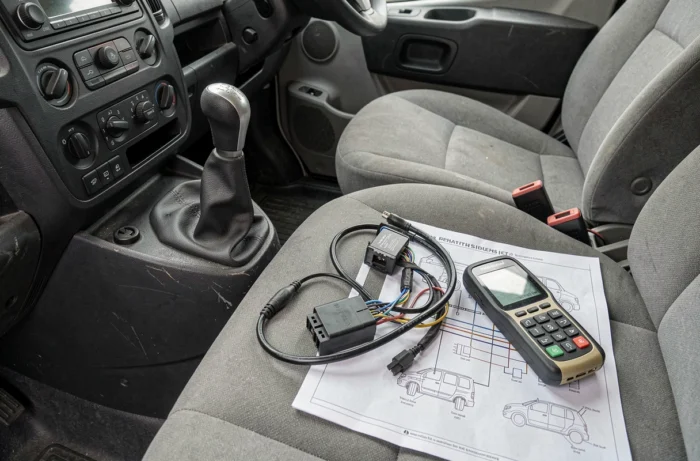
Role of the BSI and Transponder in the Anti-Theft Chain of the Boxer
The BSI (Intelligent Service Module) centralizes the electronic management of the vehicle. On the Peugeot Boxer, it receives the code emitted by the transponder chip of the key, compares it to its internal memory, and then authorizes (or blocks) fuel injection via the engine control unit.
This dialogue occurs in a matter of milliseconds. If the code does not match, the BSI sends a blocking order to the control unit. The starter may turn, but the engine does not start due to lack of injection.
The transponder is a passive chip powered by the ignition lock antenna when the key is inserted. Over time, the antenna coil may degrade, or the chip itself may lose its programming. A faulty transponder produces the same symptom as a malfunctioning BSI, hence the importance of testing with the second key mentioned earlier.
When the BSI Needs to Be Replaced or Cloned
A defective BSI cannot be “repaired” in the traditional sense. On the Boxer, replacement involves cloning the original module or individual programming with a compatible manufacturer tool, such as DiagBox or Lexia. Without this step, the new BSI will not recognize any key, and the vehicle will remain immobilized.
Entrusting this operation to a specialized automotive electronics technician prevents ending up with a new but unusable BSI. Cloning transfers the key/control unit pairing data from the original module to the replacement module.
Immo Off Procedure on Peugeot Boxer Control Unit: What It Involves
The software deactivation of the anti-theft system, known as Immo Off, involves modifying the mapping of the engine control unit so that it ignores the absence of a signal from the BSI. The control unit then starts without checking the key’s authentication.
This intervention is performed through the vehicle’s OBD port, using a reprogramming tool capable of reading and rewriting the firmware of the control unit. On Boxers equipped with Marelli or Bosch control units, the procedure varies depending on the generation of the component.
Technical Limitations of Immo Off
A generic multi-brand OBD scanner is usually insufficient. Tools capable of modifying the immobilizer layer are professional-grade equipment, and the manipulation requires knowledge of the exact structure of the calibration file.
An error in writing the firmware can render the control unit completely inoperative. The main risk is “bricking” the control unit, turning a recoverable failure into an expensive module replacement.

Legal Consequences and Insurance After Deactivation of the Anti-Theft System
Deactivating a vehicle’s anti-theft system alters its level of protection against theft. In France, insurers factor in the presence of an immobilizer system when calculating the premium and theft warranty conditions.
If the vehicle is stolen after an Immo Off deactivation, the insurer may refuse compensation by citing a modification of the original security device. Deactivation is not illegal in itself, but it alters the insurance contract.
For a utility vehicle like the Boxer, often used in a professional context, the loss of theft coverage represents a significant financial risk. Before any definitive intervention, checking the terms of the insurance contract remains a basic precaution.
The least risky solution is to address the actual cause of the blockage (transponder, antenna, BSI) rather than removing the system. Replacing the transponder chip or cloning the BSI restores normal operation without affecting the vehicle’s insurance coverage.