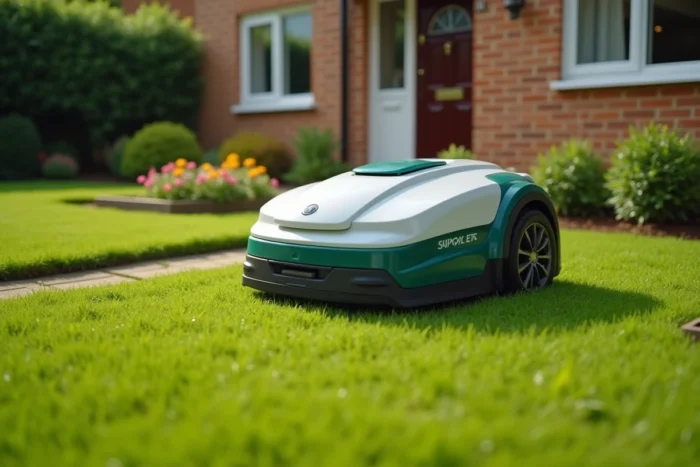
The Parkside PAMRC 250 A1 City Smart robotic mower, sold by Lidl for less than 200 euros, positions itself as one of the most affordable models on the French market. At this price, the question is not whether it mows, but what it sacrifices to maintain this price, and whether these compromises are acceptable for a small garden.
Parkside PAMRC 250 A1 compared to competing robotic mowers: technical differences
Comparing the Parkside to other entry-level or mid-range robots allows us to assess what the low price entails in terms of capacity and features.
| Criterion | Parkside PAMRC 250 A1 (Lidl) | Mid-range robot (400-600 euros) |
|---|---|---|
| Indicative price | Less than 200 euros | 400 to 600 euros |
| Announced maximum area | 250 m² | 500 to 1,000 m² |
| Zone delimitation | Perimeter wire (guide wire) | Perimeter wire or RTK/navigation camera |
| Connectivity | Bluetooth (smartphone app) | Wi-Fi or Bluetooth, sometimes GPS |
| Rain sensor | Yes | Yes (standard on most) |
| Schedule programming | Yes, via app | Yes, often more granular |
| Battery voltage | 20 V | 18 V to 36 V depending on models |
The Parkside covers a maximum area of 250 m². This is a clear limit. A typical suburban garden often exceeds this area, making the robot unsuitable for a significant portion of potential buyers.
For those with a small urban lot, a patch of lawn, or a terraced house garden, this capacity is sufficient. Before considering the price a bargain, one must measure the actual area to be mowed, including pathways and corners.
Installation of the perimeter wire and constraints of the Parkside Lidl robot
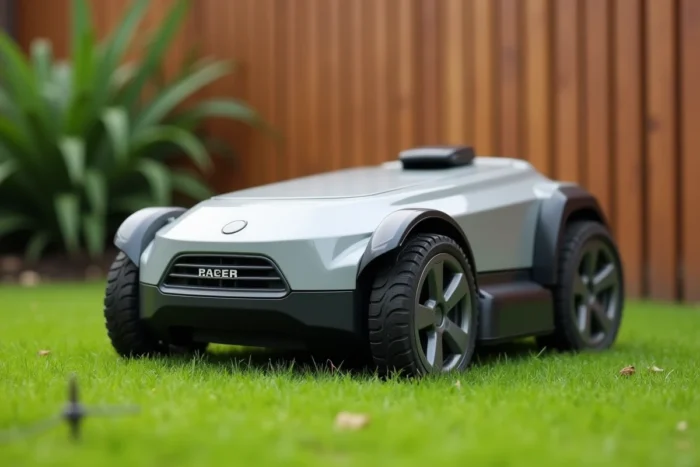
The Parkside uses a perimeter wire delimitation system. This wire, buried or secured to the ground with stakes, defines the mowing area. Installation takes time, especially if the garden has flower beds, borders, or trees to navigate around.
Several users who shared their reviews of the Parkside robotic mower at Lidl report that laying the wire is the most demanding step. On a regular and clear terrain, the operation remains simple. In a garden with multiple obstacles, it can take several hours.
Bluetooth connectivity, unlike Wi-Fi, requires staying close to the robot to control it via the app. No control from inside the house if the walls are thick or if the distance exceeds a few meters. This technical choice contributes to cost reduction.
- The perimeter wire must be laid away from hard edges (walls, slabs) to prevent the blades from coming into contact with these surfaces.
- Steep slopes can be problematic: entry-level robots generally struggle beyond moderate inclines.
- The rain sensor returns the robot to its base in case of rain, preventing mowing on wet soil and leaving wheel tracks on the lawn.
European Regulation 2023/1230 on machines: what changes for robotic mowers
The Regulation (EU) 2023/1230 on machines will come into effect on January 20, 2027. This text directly concerns autonomous machines, including robotic mowers used in private gardens. Safety requirements will be strengthened, particularly regarding risk management covering the entire product lifecycle and the quality of documentation provided to users.
A lesser-known point concerns the modification of devices. With this new framework, any substantial modification of a machine can equate its author to a manufacturer. Adapting the perimeter wiring with unapproved components, adding a third-party module, or disabling an original safety feature: these practices, common on entry-level products, would expose the DIYer to the same compliance obligations as a manufacturer.
For a robot sold for less than 200 euros, the temptation to tinker exists. Replacing blades with unapproved models, modifying the charging station, or extending the perimeter beyond the manufacturer’s specifications are common interventions. After January 2027, these modifications will take on a new regulatory dimension.
Noise, autonomy, and maintenance of the Parkside 20 V robotic mower
The operation of the Parkside is described as significantly quieter than a traditional gas mower. This point matters for users in densely populated residential areas, where mowing time slots are regulated by local noise nuisance laws.
The 20 V battery powers a mowing cycle suitable for small areas. Over 250 m², the robot does not need marathon autonomy. It returns to its charging base when the battery level decreases, then resumes mowing if the schedule requires it.
Maintenance is limited to periodic blade replacement (small pivoting blades, inexpensive) and cleaning the chassis. The perimeter wire can be damaged by a spade or lawn aerator: its repair is simple but requires locating the break, which can be tedious without a dedicated detector.
Parkside under 200 euros: for what type of garden
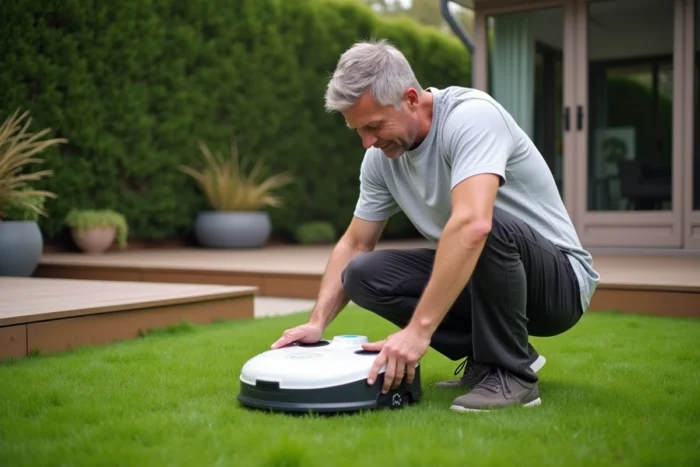
The Parkside PAMRC 250 A1 meets a specific need: to automate the mowing of a small urban or suburban garden, flat and not cluttered with obstacles. Outside of this framework, its limitations become flaws.
- Suitable: city garden, grassy terrace, small lawn area under 250 m² without marked slope.
- Limit: terrain with many flower beds, winding paths, or steep slopes.
- Unsuitable: area over 250 m², garden fragmented into several unconnected zones, uneven terrain.
The price under 200 euros does not make the Parkside a bad product. It makes it a product with a narrow usage scope. Within this scope, the offering remains coherent: schedule programming, rain sensor, automatic return to base, contained noise level.
The decisive factor remains the area. Measuring your garden before purchase, including overlapping areas and narrow passages, avoids costly disappointment, even at under 200 euros.