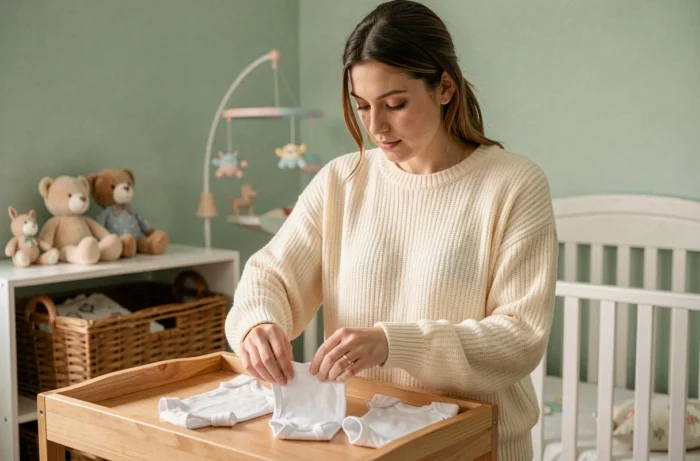
Preparing for a baby’s arrival often starts with a shopping list that grows longer as research progresses. However, the essentials for welcoming a baby can be categorized into a few targeted groups. The classic trap is buying equipment too early that won’t be used for several months, or even ever.
Parents’ Mental Health: The Great Omitted Factor in Baby Lists
Checklists detail childcare equipment in minute detail, but the psychological preparation of new parents is absent. Yet, this is the factor that weighs the most during the first weeks.
The parental burnout syndrome affects a significant portion of parents in France, mainly women. It is not just simple fatigue. It is a recognized state, distinct from classic depression.
A strengthened parenting pathway for 2025-2027 has been announced to integrate the screening of parental burnout into standard follow-up. An exhausted parent can now make an appointment directly with a contracted psychologist, without going through their general practitioner.
Even before buying a crib or stroller, identifying postnatal support resources nearby (independent midwife, PMI, perinatal psychologist) is part of the true essentials. Home postnatal follow-up by a midwife is also reimbursed at 100% by Health Insurance. Young parents preparing for their child’s arrival on bullabebe.com also find useful guidelines to structure their purchases without succumbing to panic.
Newborn Sleep: Choosing a Suitable Crib Without Overloading the Room
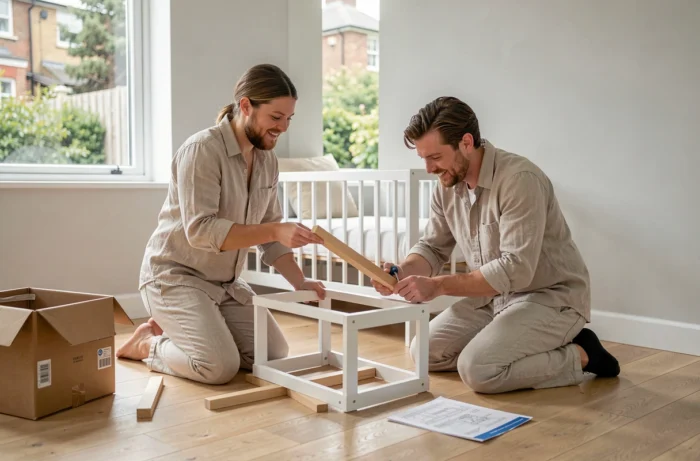
The sleeping arrangement is the first concrete decision. Are you hesitating between a cradle, a crib, or a bassinet? The answer depends on the available space and the desired duration of use.
A crib that meets NF EN 716 standards covers needs from birth to about two years. The cradle, being more compact, is suitable for the first months but will soon be abandoned. If the budget is tight, going directly for the crib avoids an intermediate purchase.
Mattress and Bedding: The Bare Minimum
The mattress must be firm and perfectly fitted to the dimensions of the crib (no gaps between the mattress and the bars). The sleeping bag replaces the duvet and blanket, both of which are not recommended for infants.
- Two or three cotton sleeping bags allow for rotation between washes, adjusting the thickness to the season.
- Two fitted sheets are enough for the crib. A third serves as a backup in case of a restless night.
- A waterproof mattress protector keeps the mattress safe without adding thickness or excessive warmth.
The ideal room temperature is maintained between 18 and 20 degrees. A simple room thermometer is more reliable than a parental feeling biased by fatigue. There’s no need for a connected video monitor from birth if the crib is in the parents’ room.
Infant Feeding: Breastfeeding or Bottle-Feeding, Two Different Preparations
The chosen feeding method completely changes the list of equipment. Why is this choice so structuring? Because it determines not only the purchases but also the daily organization of the first weeks.
Breastfeeding
The equipment is minimal: two or three nursing bras, washable pads (preferably), and a nursing pillow to relieve the back and arms during feedings.
A breast pump can be rented at the pharmacy rather than purchased, which reduces expenses for a sometimes limited-time use. One or two bottles remain useful for storing expressed milk.
Bottle-Feeding
Count on four to six small bottles for the first weeks. A dedicated bottle brush is more effective than a regular sponge. A sterilizer is not mandatory if cleaning is thorough, but it reassures some parents.
A bottle warmer is a comfort, not a necessity. A water bath works just as well, even at three in the morning. The purchase can wait to see if the bottle-feeding schedule justifies the investment.
Baby Budget for the First Year: Balancing Between New and Second-Hand
The cost of a child’s first year weighs heavily on the family budget. A majority of French people believe that having a child represents a significant expense today.
The stroller, car seat, and crib account for the bulk of the material budget. Everything else (clothing, small accessories, linens) can easily be found second-hand in excellent condition, as the duration of use by a single child is short.
- The car seat is the only piece of equipment that should preferably be bought new, to ensure there has been no invisible prior impact (the internal structure can be weakened without external signs).
- Newborn clothes in size 0-3 months are used for only a few weeks. Opting for second-hand lots can reduce the bill by three or four times.
- The changing table can be replaced by a simple changing mat placed on a stable dresser, avoiding an additional piece of furniture.
Before buying, check the baby registry: friends and family often gift the most visible items (stroller, bouncer, clothes). It’s better to guide loved ones towards what is expensive and keep smaller adjustable purchases for after the birth.
Diapers and Hygiene: What is Needed Right After Returning from Maternity
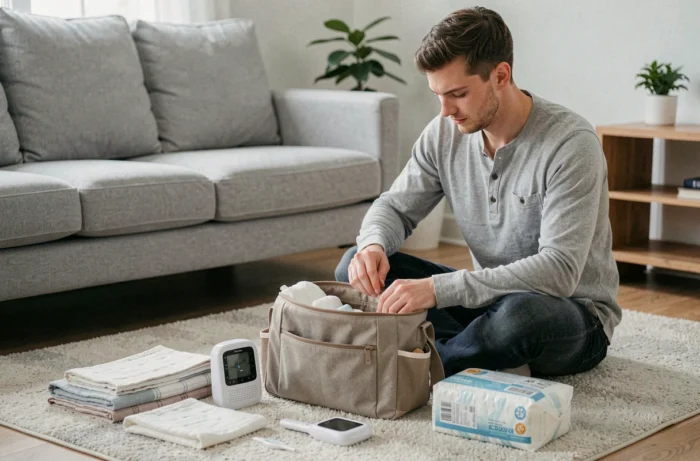
Diaper changes take up a disproportionate amount of time in the first weeks. A newborn uses between six and eight diapers a day, which necessitates a minimal stock right from the return home.
For bathing, a baby bathtub (or a simple bath support) and a gentle, fragrance-free wash gel cover the needs. Daily baths are not recommended for newborns: two to three times a week are sufficient to maintain the skin barrier.
Physiological saline in single-dose packets remains the most commonly used hygiene tool in the first months, for the nose, eyes, and cleaning the umbilical cord. Having a box in advance avoids a trip to the pharmacy in the first days.
The complete toiletry kit (rectal thermometer, nasal aspirator, rounded nail scissors) fits in a pouch. There’s no need for a dedicated piece of furniture or a complex organization for the daily care of an infant.