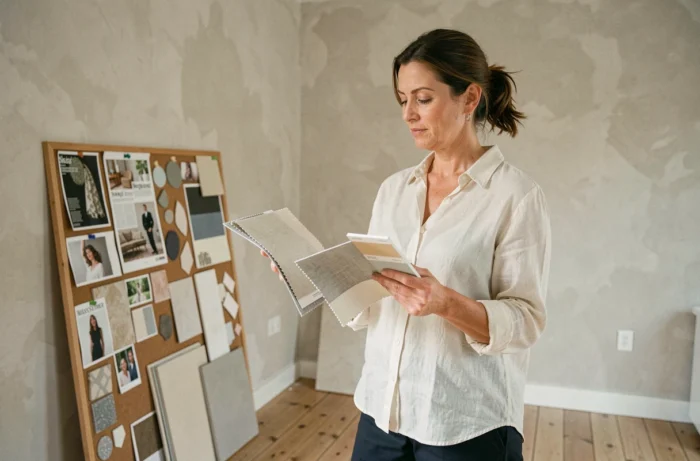
A freshly painted wall, a sofa delivered the day before, and yet the room remains bland. The problem rarely lies in the main furniture: it is the complementary items (lighting, textiles, decorative coverings) that set the tone. Choosing these elements without a method is like assembling pieces from different puzzles. Choosing your interior decoration equipment well starts with understanding the technical constraints of your space before thinking about colors.
Formaldehyde emissions: the health criterion that changes the choice of decorative furniture
It is often forgotten, but a decorative piece made of reconstituted panel (MDF, particleboard) emits volatile organic compounds into the indoor air. In recent years, European regulations have tightened on this point.
The new REACH restriction imposes, starting from August 6, 2026, a limit of 0.062 mg/m³ of formaldehyde for wood-based furniture intended for indoor use. Other affected items will have a limit of 0.080 mg/m³. In practical terms, a decorative sideboard or a low-end particleboard wall shelf may no longer be compliant.
For us, buyers, this means a simple reflex: check if the manufacturer mentions REACH compliance or tests according to EN 717-1 or EN 16516 standards. A certified low-emission panel or solid wood remains the safest choice for a healthy interior. When reviewing the equipment offered by Deco Asaiss, we notice that this issue of materials arises from the very first selection filter.
In France, VOC labeling (classification A+, A, B, C) is mandatory for paints, varnishes, and floor coverings, but not for furniture. The result: one can buy a decorative dresser without any indication of its emissions. The absence of a label does not mean the absence of risk. Asking the seller for the technical data sheet or prioritizing environmental labels (Blauer Engel, NF Environment) remains the only safeguard.
Consistency of materials and textures in the same space
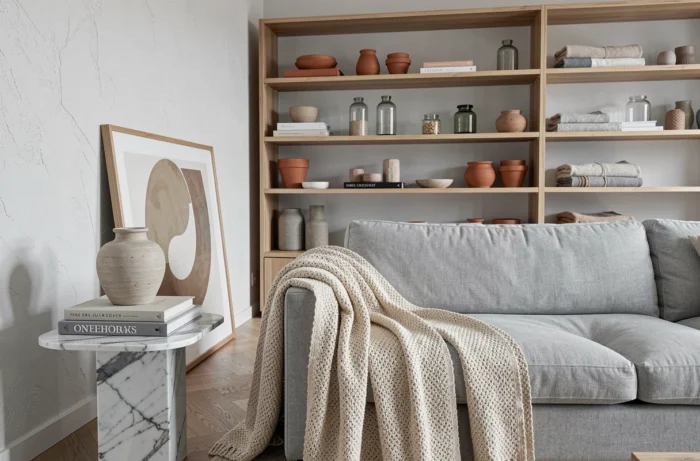
Starting from a concrete situation: a living room with light oak flooring, white walls, and a gray fabric sofa. We want to add a light fixture, cushions, a rug, and a decorative object. The classic trap is to choose each piece in isolation, in-store or online, without considering the coexistence of materials.
Limit the material palette to three families
Three families of materials are enough to structure a room without overloading it. For example: wood, linen, and black metal. Each new piece of equipment must belong to one of these three families or visually resemble them.
- Wood (solid or certified low-emission veneer) brings warmth and works well for shelves, frames, and lamp bases.
- Linen or thick cotton covers textiles: curtains, cushions, throws. Their visible texture breaks the monotony of smooth surfaces.
- Metal (matte black, brushed brass) structures lighting fixtures, handles, and small objects. It adds contrast without weighing down the space.
Mixing more than three families of materials creates a cluttered impression, even with individually successful pieces. You gain coherence what you lose in variety, and the visual result is much more readable.
Play on texture contrasts rather than color
In an interior with neutral tones, differentiation comes through visual touch. A corduroy cushion next to a twisted knit throw creates more relief than a yellow cushion placed on a gray sofa. Reactions vary on this point according to tastes, but the rule works well in modest-sized spaces where too many colors visually shrink the room.
Decorative lighting: layering light sources
A central ceiling light decorates nothing. It poorly illuminates and flattens volumes. Lighting decoration relies on layering three levels of lighting in each room.
The first level, ambient lighting, comes from a pendant or a floor lamp directed towards the ceiling. The second, functional lighting, targets a specific area: a reading light near the sofa, a desk lamp. The third, accent lighting, highlights an object or a wall using adjustable spots or a discreet LED strip.
Layering these three levels transforms a flat room into a structured space. You can modulate the ambiance according to the moment: reading, dining, evening. The choice of decorative light fixture (rattan pendant, brass wall sconce, ceramic lamp) always fits within the material palette defined above.
A technical point often overlooked: the color temperature of bulbs. Below 3,000 kelvins, the light leans towards warm yellow, suitable for the living room and bedroom. Above, it becomes cold and clinical. Mixing different temperatures in the same room disrupts harmony just as surely as a poorly mastered mix of styles.
Wall decoration and objects: proportions before style
One often chooses a frame or a mirror for its pattern, only to find that it is too small for the intended wall. The operational rule: a wall element should cover between half and two-thirds of the width of the piece of furniture below it. A 40 cm painting above a 160 cm sideboard floats in the void.
For a composition of several frames, first lay the whole set on the floor, adjust the spacing (a few centimeters between each piece), and then transfer the positions to the wall. This step avoids unnecessary fixing holes and ensures a balanced result.
- A large-format mirror visually enlarges a narrow hallway, provided it is placed facing a source of natural light.
- Open shelves serve as a decorative support if you alternate books, objects, and empty space. Filling every inch cancels the effect.
- Plants (real or stabilized) bring organic volume that manufactured objects do not replicate.
The choice of style (Scandinavian, industrial, bohemian) comes after these questions of proportion and arrangement. A well-proportioned object in a style that is not ours works better than a “perfect” object that is poorly sized.
Interior decoration is built in successive layers, each subject to concrete constraints: air quality, coherence of materials, lighting levels, wall proportions. Resolving these technical points before letting oneself be guided by the crush is the difference between a space that lasts and an interior that one will want to redo in six months.